Role: Creator
Team: Solo
Players: 2+
Trading Card Game
Tools
Excel | Tabletop Sim | Obsidian | Clip Studio
Overview
Project Elements is a TCG (Trading Card Game) that takes inspiration from other TCG’s such as Yugioh, Magic, and Lorecana.
The game revolves around building your stronghold, advancing it from stage 1 to 20 and successfully defending it for a turn before finally claiming victory. Players utilize a variety of resources from creatures, spells, and equipment and more to overcome their opponent and be the first to build their stronghold.
There are a variety of different card archtypes each one focuses on a different core mechanic of the game and explores different ways that it can be used. Mechanics such as Units, Spells, Drawing, Resources, Certainty and more, but it will often explore different ways to utilize those mechanics and encourage a variety of different playstyles.
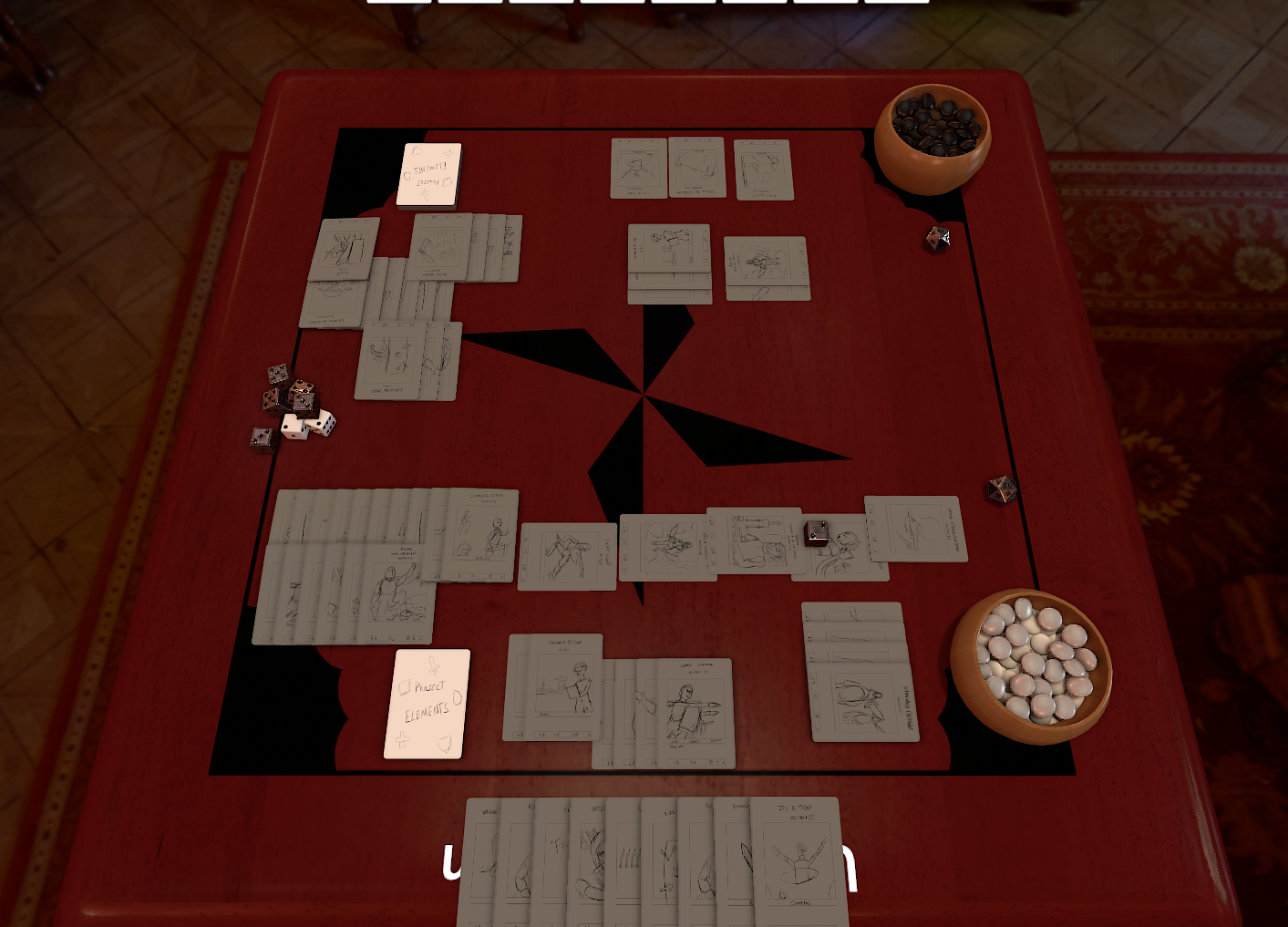
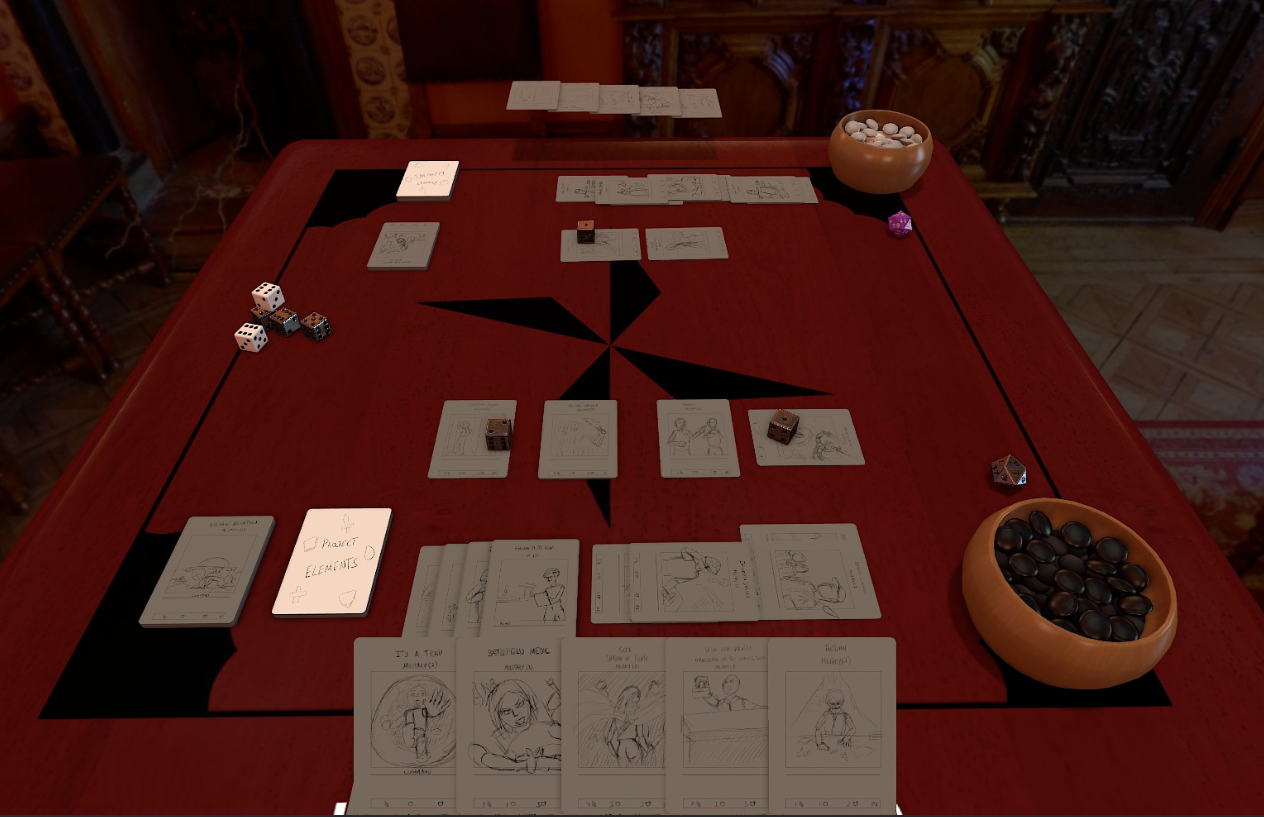
Project Elements is designed to be a flexible and expressive card game that allows players who love playing card games to play card games with each other. This game is being tested using tabletop simulator, and I have currently verified its game systems, mechanics and core experience.
Project Goals
- Play Cards: Players have fun drawing and playing cards. So lets let them draw and play cards.
- The Game Does Not Make Me Lose: Mitigate frustration caused by systems that elicit “I lost because of X rule.” or “It’s hopeless because X rule means I don’t feel like I can win.”
- It’s always playable: Every type of deck can deal with every problem that appears on the board. It just may require more investment from some decks, then others.
- Interaction: Create an interactive card game that allows players to go back and forth against one another, utilizing a variety of mechanics that enable you to interact in different ways.
- You Can Do It: Create systems and cards that allow players to do cool things, even when things feel unlikely.
- It’s A 2 Player Game: Both players should have fun, both winning and losing.
- No Deck Left Behind: Create archtypes that revolve around mechanics and enable different combinations and ways of playing the same cards.
- Understandable: Digestable and intuitive design to allow players to grasp and play.
Responsibilities
- Design core mechanics and systems that encourages player interaction, creative strategies, and fosters a variety of ways to play.
- Design cards, card types and archetypes that support a variety of ways to play, expanding potential strategies through creative combinations with other cards or gameplay systems.
- Analyze and refine card strength to maintain game balance, while preserving its value and impact supporting other strategies, use cases and card combinations.
- Craft features that explored different ways mechanics, and core systems can be used to drive gameplay, gamefeel and develop additional playstyles.
- Develop terminology, procedures and methods to improve onboarding for new players, and reduce the congitive load of unintended heavy areas of attention.
- Organize, recruiting, recorde, and evaluate Playtesting sessions to improve User Experience and ensure cards and gameplay were hitting target goals.
- Investigated established card design techniques and adapted or developed new approaches to support the game’s distinctive mechanics and intended player experience.
- Draw Proxy Art for cards so that players have visuals that they can use to quickly identify what the card is, and draw connections to its effects and value.
- Develop scenarios, and test decks for players to use during playtests to ensure that relevant features were tested to obtain accurate and actionable information.
Additional Details
- Genre: Card Game
- Duration: 2026
Detailed Work And Breakdown Of The Game
1.0 What is the Game?
Project Elements is a highly interactive card game which is designed to support a variety of different playstyles. The only thing you need to play is a 50 card deck which you assemble prior to playing which consists of cards specific to the card game. You can use supporting items such as tokens, dice and other supplmentary tools to help track and represent dynamic information.
The objective of the game is to build your stronghold by incrementing your stronghold rank from 0 to 20 over the course of each turn. When a player reaches rank 20, they must defend their stronghold against their opponents next turn before they can claim victory. If the opponent manages to reduce the rank below 20 before the end of their turn then the game continues. Otherwise they lose.
Players use units as the primary way to interact with the game. These units can build your stronghold, protect it, or go on the offensive to attack your opponent’s units or stronghold.
A player can build their stronghold or reduce an opponents stronghold by expending an active unit card. The amount of cards that are expended will either increase or reduce a strongholds value by the same amount. For example, if I expend 3 units to build, then my stronghold value increases by 3.
You cannot reduce a stronghold’s rank below 0 and you cannot increase it beyond 20. You also cannot attack your opponents stronghold if they control a unit that can protect it.
A unit card is the most common card type. It has a name, an image, and a number of other critical pieces of information such as the archetype it belongs to and the cost to play the card. There are four key stats a unit can have; Attack (The attack power of this unit while it is Active), Counter (The Attack power of this unit while it is defending), Health (The total damage the unit needs to take before it is defeated), and Resistance (The amount of damage this unit ignores each time it takes damage)
Many units have abilities which a player can trigger by expending that unit. Some abilities activate when the unit is played, some are always on and others can be activated at will.
There are two major unit categories. A basic Unit, and a Legend. The basic unit is the most common type unit. However a legend is a named card which a player can only have a single copy of in their deck. These cards are powerful and have additional features that make them both valuable for the their allies and targets for their enemies.
To play a card you must spend resources equal to its cost with at least one of those resources being the same archtype as the card being played. The most common way to play a card is to expend cards equal to its cost from your resource zone. To get cards in your resource zone you can place one unit card from your hand into that area in the active state. You can only perform this action once each turn. All expended resource cards become active at the start of your turn.
When you play a unit card they arrive on the battlefield in the Attacking Position also known as the Active state. This is represented with the card oriented in portrait mode. If the unit is expended in anyway they are turned sideways into the expended or defending (landscape) state.
Active Units may target another unit for an attack in order to remove them from the battlefield. This is called a duel. An active unit that attacks another unit is expended and forced to defend after the duel has concluded. A unit that is defeated goes to the discard pile. Units that survive a duel are damaged, and have a counter place on them to represent how much damage they have taken. This is typically done through the use of a six sided dice.
Players can play as many cards as they like so long as they have the resources to pay the cost of those cards. Cards are most commonly played from the hand, however you may play a card from your resource zone by paying 1 plus its original cost. However the card you are attempting to play must be active after you pay the cost to play it.
Actions can be taken in any order as long as that action is available to you to perform.
There are many different types of cards in Project Elements. Some types work universally, while some types are focused on an archetype to to how it utilizes that archetypes mechanics. For example, Spells are available to multiple different archtypes, where as Commands are part of the Military Archtype. Below is an example of some of the different types of cards that exist;
| Card Type | Special Use | Card Example | Card Effect |
| Battlecry | Requires Active unit on field. Reduce cost by cost of unit used to activate. | Warcry | Give ally units bonus Attack. Ready Ally units. |
| Command | Normal Cost to play. Can be played on enemy turn through an ally leader. | Brief Respite | Send one unit back to hand/deck. Then that player draws. |
| Equipment | Attach to a unit on the field. Give unit bonus effect. | Sword of Bravery | Unit can attack twice this turn before being expended. |
These card types are all available in the Military archetype, however that does not mean the archetype must or would use all of these card types at once. Card types exist to support other ways of playing cards. They are designed to promote different strategies and ways to play with an archtype to allow for players to explore ways to build a deck that synergizes with how they want to play the game.
Archetypes are the classification given to cards that indicate what group they belong to. In Magic that is the Colour, in Lorcana it is the Ink, In yugioh it is the attribute. They are called Archetypes because they represent a theme in this game. Military, Arcana, Nature, Academic are an example of archetypes.
There are a limited number of archetypes and each archetype focuses on exploring one of the core aspects of the game. Military for example focuses on Units on the field. Their cards explore the variety of ways that can be utilized. Another archtype focuses on drawing, and another on playing cards.
This design system allows players to explore a variety of playstyles in different ways. It gives provides different avenues, and points of connection for players to experience playing both an archetype and the game. A swarm playstyle may share the same end goal between archetypes, but each archetype will have a different process, and objectives to reach that goal. This enabes the game to appeal to a broader audience and allows players to experiement and be creative in the way they build and play their decks.
Some playstyles are;
One important detail is that an archetype has access to everytool needed to deal with situation that occurs, however some archetypes have access to tools that make handling certain situations easier then others. Military for example, has strong individual units with good individual stats. However, they have to spend more resources dealing with a large amount of units at once. Arcana is the opposite, with weaker combat units but devasting spells that can make handling those same situations much easier.
This is an example of some of the playstyles each archetype supports in their own way;
- Swarm: Play lots of units quickly, and use your numbers to your advantage.
- Command: Play non-unit cards that focus on utilizing units on board to disrupt an opponents strategies.
- Equipment: Use equipment cards on individual units to empower them with various abilities or stats. Focuses on turning any unit into a high impact unit.
- Removal: Play cards that focus on hit and run tactics, creating a chain of actions that enables you to consantly remove an opponents units.
- Sequencing: Play around activating a series of cards in specific orders to trigger or achieve specific results and break down an enemies defences.
- Disruption: Utilize cards which focus on crowd control and use an opponents cards against them.
- Deal Maker: Play cards that revolve around conditions that are triggered by your opponent to give yourself large benefits.
2.0 Gameplay
Players start the game turn with 7 cards drawn from their deck. If a player does not like their hand at this point, they can place any number of cards from their hand at the bottom of their deck. Then they can draw the same number of cards. Players draw a card at the start of their turn. However the first player does not draw on their first turn.
During a player’s turn they can decide to do any of the following actions;
- Once per turn, put an applicable card in their resource zone from their hand.
- Play an applicable card from their hand.
- Trigger an applicable card’s effect.
As long as a player can afford to use a card, they are able to do so at any point during their turn. Any unused resources may still be expended on their opponents turn. This is because there are cards that a player can use that enable certain cards to be played on their opponents turn.
Once a player has finished with their turn, they pass it to their opponent. The cycle continues until one player surrenders or is defeated.
Elements is a game that is designed to feel familiar on its face but has a lot of underlying differences that push the way we think about designing card games and solving problems. For those familiar with other TCGs (Trading Card Games) some key differences are;
- You cannot search your deck for a card.
- You can attack on the turn you play a card
- There is no summoning sickness.
- You can attack any unit on the field by default.
- There is no Life Counter
- You cannot win on the turn you meet the win condition.
- Lots of Drawing.
- You cannot circumvent costs, but there are many ways to pay a cost.
- Focus on Gameplay mechanics for archtypes over styles of play.
- Different Card States which affect combat.
These are some of the differences that I found that have pushed a stronger focus on designing player driven cards and systems.
This game is still in development and playtesting is still underway.
I tested using players both familiar and unfamiliar with Trading Card Games. Those familiar were able to comprehend and develop strategies at a much quicker pace then those that did not which is understandable. However, those that had less familiarity had an easier time accepting the way the game worked as they had not had as much exposure to “traditional” methods of playing.
Playtests have shown players are able to pick up the core mechanics of the game and play on their own after the onboarding session and playing a single match. First time players took about one and a half to two hours to complete a match. This included questions they would ask, and looking up various pieces of information as they planned out how they wanted to play a turn.
Results from playing have shown positive reception from playtesters. I was personally concerned about how much time it would take to play a match however playtesters never mentioned time as a problem. Players expressed positive remarks to the way the game functioned, in particular the depth of strategies they could formulate and the satisfaction as they were successful in executing those strategies.
3.0 Key Challenges
One continuous challenge is in balancing cards around potential card combinations where a player can play a certain sequence or combination of cards and that will result in a state where a card is now exponentially more powerful. This can result in an oppresive situation that can be demotivating to the player.
I tend to approach solving these types of problems by looking at how to maintain the identity of the card. Why is the combination oppresive, and what power can we shave off while maintaining why the card is valuable. And this ends up requiring tailored adjustments on a card by card basis. This resulted in improvements to players perception of those combinations, and situations involving those cards have payoffs that feel rewarding, but require less invement to be overcome.
The second key challenge that I am working on in is the length of a game. This is because there are a lot of underlying design decisions that enable players to rarely be placed in a situation where they are unable to play the game. This makes closing out games difficult as currently it is difficult to achieve the primary win condition because the actions you need to take to progress in that direction, are adjacent to the actions you take to ensure you remain in a winning position.
Secondly, there is a large amount of interactivity between players. Interactivity adds time to strategies, and while it does create a positive effect on the overall gameplay. It comes at a signficant cost in time.
And third, there is a large amount of depth in the strategies that players can devise. And this can lead to players having too many options to consider. For some players this is an appealing situation and for others it is a headache.
All of these together will very quickly balloon the playtime of a match. However those times do go down as players become familiar with the cards in the game. What once took 2 hours to play, can now be done in 1 hour or 45 minutes. I am still assessing various match lengths as players become more experienced, but this is something I am keeping an eye on as familiarity is a prominent influential factor in all of these aspects.
The third challenge is in creating meaningful shifts in the way you play a deck. Cards should be playable in different playstyles. However, you quickly run into a challenge where the current foundation of cards doesn’t support that style due the way the system is built in that moment. And so we need to adapt the system and need to design cards to enable that playstyle to exist. But in that process you have to be careful that you are not creating potential combinations that erode an existing playstyle.
And so this leads to the challenge that I am constantly working on during this game which is developing systems and cards that allow for these playstyle to exist within a shared ecosystem. Building the playstyle is not as much of a challenge on its own. The challenge is in having it share the space with other playstyles, while ensuring it succeeds at fufilling its target player’s desires.

