Role: Lead Developer
Team Size: 1
Players: 1
Engine: Unreal
Tools
Excel | Clip Studio | Huion Kamvas Pro | Unreal Engine | Audacity
Overview
The Game
A 2D handdrawn Decision Making Resource Management Role Playing Game where you as the player take on the role of a teenager who has just experienced a great loss. A fire has consumed your home and your parents and you find yourself homeless on the streets. There is hope as you have an opportunity to get into subsizdized housing however you need to to accomplish a series of tasks in order to be eligable.
You need to survive 14 days on the streets and hopefully by the end of those 14 days you have fufilled the conditions you need to move in to this new home. Along the way, you need to acquire funds for a deposit. You need to build connections to get a recommendation in this competitive environment. And you need to maintain you hygine all while attending school and other activities.
My Role: Designer and Developer
My role on this project was to be the lead developer. I took over the project from another team and rebuilt the entire game under a new vision. Utilizing Unreal, I designed the entire game, wrote the logic and narrative, as well as drew close to 1000 images to support the scenarios that players would interact with. I shipped this game on time 1 year from signing on to the project after it had been in limbo for over 3 years.
Project Desires
I wanted to create “Home” as a game that felt authentic to the struggle of homelessness. It had to put players in that perspective, without losing its identity as a game. Its a choose your own adventure style game, but it needs to feel like a true game with mechanics. I wanted player choice to be at the forefront of this experience to players could try to survive as they would try themselves. I wanted their to be character from different backgrounds, with different connections, and I wanted their to be able to show different stories that might often be misrepresented, or undervalued but still contained content that could be interesting or otherwise engaging. And I wanted the experience to feel like there is a narrative that you are creating.
Project Design Goals
- Balance authenticity of content with gameplay to create an intimate player driven game.
- Build a system that utilizes decision making as a core mechanic.
- Create strong, interesting scenarios that place players in situations where they make compelling and difficult decisions.
- Develop ways to easily create, manage and fix situations out of engine.
- Develop a variety of events, with different ranges of experiences, depth, content and choice.
- Raise awarness of youth homelessness and the struggles that it encapsulates.
- Create meaningful player driven choices that are reflected in the player experience both narratively and mechanically.
Responsibilities
- GAME DESIGN: Designed and developed all systems, content, and tools with limited resources, clarifying goals to deliver a game that empowered players autonomy to approach and experience its challenges.
- GAME DESIGN: Drove research and collaborated with subject matter experts to inform the game authentically represented youth homelessness across its scenarios, mechanics, loop, and overall experience.
- LEVEL DESIGN: Developed over two hundred scenarios with multiple variations, rewards, outcomes and interactions designed to tell a single story that players could interact with.
- USER EXPERIENCE: Conducted play sessions and developed a long-term evaluation method, analyzing gameplay data, interviews and information retention to understand how memory shaped user perception of events. This identified key emotional and cognitive moments, and assessed their effectiveness.
- NARRATIVE DESIGN: Develop an overarching narrative for the game, along with multiple individual stories and narrative arcs for different player paths and connecting stories which all came together to form one cohesive narrative to capture the player’s journey.
- GAME DIRECTION: Revive and lead the development of a stalled game project, collaborating with contractors to design, develop, and deliver a final product that aligned with project goals and requirements.
- PROGRAMMER: Implement character logic, world systems, and gameplay mechanics to ensure game functionality that meet the requirements of the designed systems.
- PROGRAMMER: Developed custom tooling utilizing the Unreal Engine 4 that streamlined the creation of scenarios that drove player gameplay. This resulted in tools that expedited scenario creations, editing, testing and iteration in real time, that could impact fixes from taking minutes to seconds.
- 2D ARTIST: Created over one thousand images that protrayed events in game which provided tailored visuals that matched their playthrough.
- TECH ARTIST: Designed and integrated small scale shaders to create visual effects for transitions, UI and other similar features.
- SOUND DESIGN: Managed audio production by recording, sourcing, and editing audio assets for gameplay interactions, feedback systems, and immersion.
Additional Details
- Genre: Choose Your Own Adventure Role Playing Game
- Duration: Sept 2017 – July 2018
- Platform: PC
- Controls: Mouse & Keyboard
Detailed Design: Game Breakdown
“Home” was a challenging production. It was a project that had a full year of development, with a limited budget and a lot of content that needed to be done. When I joined the team it had been in a stalled development for over four years and I was responsible for taking over the project and rebuilding it from the ground up. This is what I would classify as my the project I was in charge of in a professional capacity.
There are many things looking back that I would have done differently. The primary change would be to the way I manage scenarios. In engine, you only need to create the scenario file and populate it with what images that were needed. The rest could be done outside and be imported in through a tool I developed to make it quick and easy to create content and make changes. This was very useful duing playtesting, as fixes were usually just a text editor away.
However, this setup was limiting from a content creation perspective. The primary issue was that it was not set up for large scale scenarios where choices could take you a dozen nodes deep. It quickly revealed some hard limitations I had not expected during implementation that required fundamental changes to maintain the experience the game provided.
Secondly, it made alternate ways of playing impossible. Everything was limited to the specific way players were originally intended to interact with the game. It did what was intended, however it heavily stifled additional ways to play that could dramatically improve the overall experience.
Third, I would change the way the Hub portion of the game functions. I originally wanted a world map that players could navigate around which I feel is a better fit for the game’s direction. The current method works but has severe limitations and doesn’t fit as effectively with the experience that was being conveyed. Unfortuntanetly this shortcoming was due to my own limitations at the time.
The other aspects would just be to improve on the visuals and the content. While they did work, the tight deadlines meant that quality control was not as consistent as I would have liked, and there are many areas where I look back at now and can see much stronger revisions that would could be done.
Overall, I am proud of the work I did on this project, however it is also a product that represents my skills at that time. And like so, I can appreciate and understand its strengths, but also learn from it so I can make better games in the future.
THE GAME
In “Home” (I Want To Go Home), You take on the role of a high school teenager who finds themselves homeless almost entirely overnight. After being rescued, you discover an opportunity to move into a subsized shared apartment for people in similar situations.
But, there’s a catch. To qualify for this opportunity, you’ll need to complete a few tasks.
First, You need to provide money to cover a portion of the rent. Secondly you need a new government issued ID. Finally, due to how heavily contested this opportunity is, you may also need a recommendation from an adult like a school teacher, or an employer. While not necessary, this helps guarantee your spot against others who want to claim that opportunity for themselves or have that recommendation.
You are given 14 in game days to complete this objective. Over this time, you have to survive in the world, managing your resources while dealing with whatever situations come your way. It’s a tight balancing act as you make difficult choices. You have to prioritize certain activities, while giving up on others, creating goals for yourself and ways to reach them in these difficult circumstances. One wrong step can quickly snowball out of control, but there are always ways to recover.
How you play is up to you. There are many options to explore, and stories to experience. It is the culmination of what you go through over the next two weeks that shape the story you create for yourself.
Gameplay
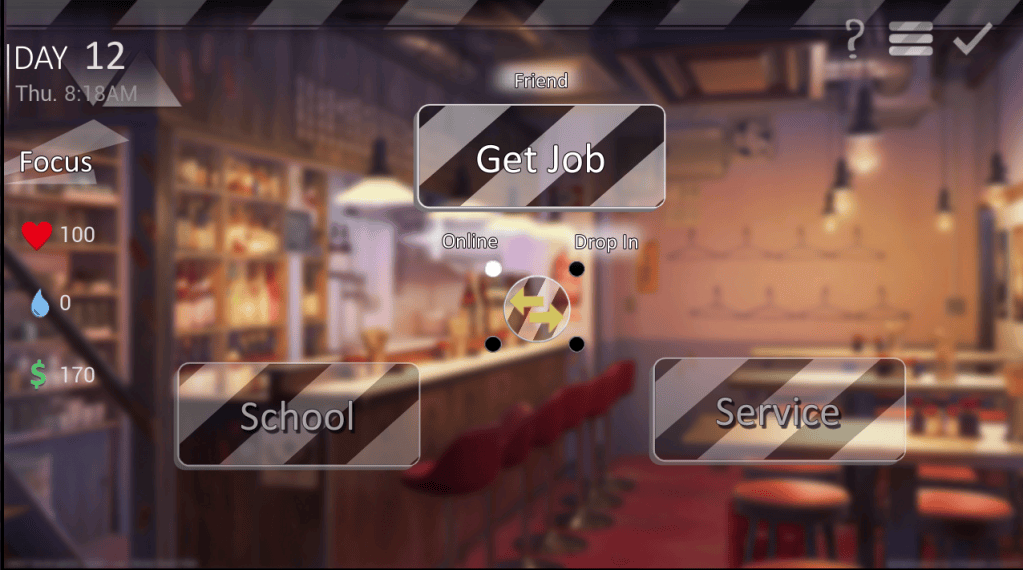
“Home” revolves around players making choices on what activities they want to do, and how they want to do them. Looking to clean up? Use a sprinker, or a public washroom. Try the thrift store for some cheap clothes, or buy some new ones. There’s a show at the rec room, or you can do it at a motel.
There are many options available to you, what makes this mechanic stand out is how you choose to do things. The what, when, why, where, how is up to you, extending to all activites you can do. Choice takes the lead, with other game mechanics and systems designed to support the different ways, meanings and outcomes of your choices.
There are two main types of choices. The first choice revolves around what type of activitiy you want to do. You’ll approach this with an outcome you want in mind. For example, I want to get fast food, I want to earn money from my job, I want to relax and draw for an hour. This is done in the “Hub” area of the game and takes place between scenarios.
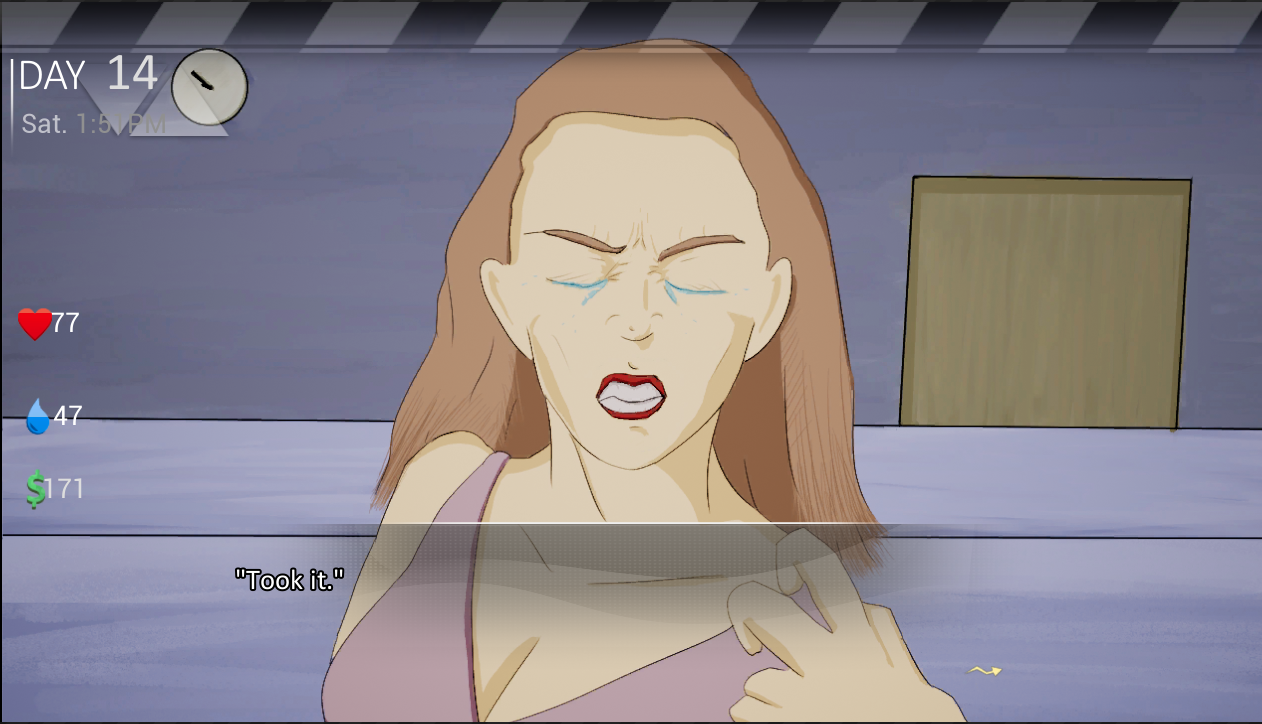
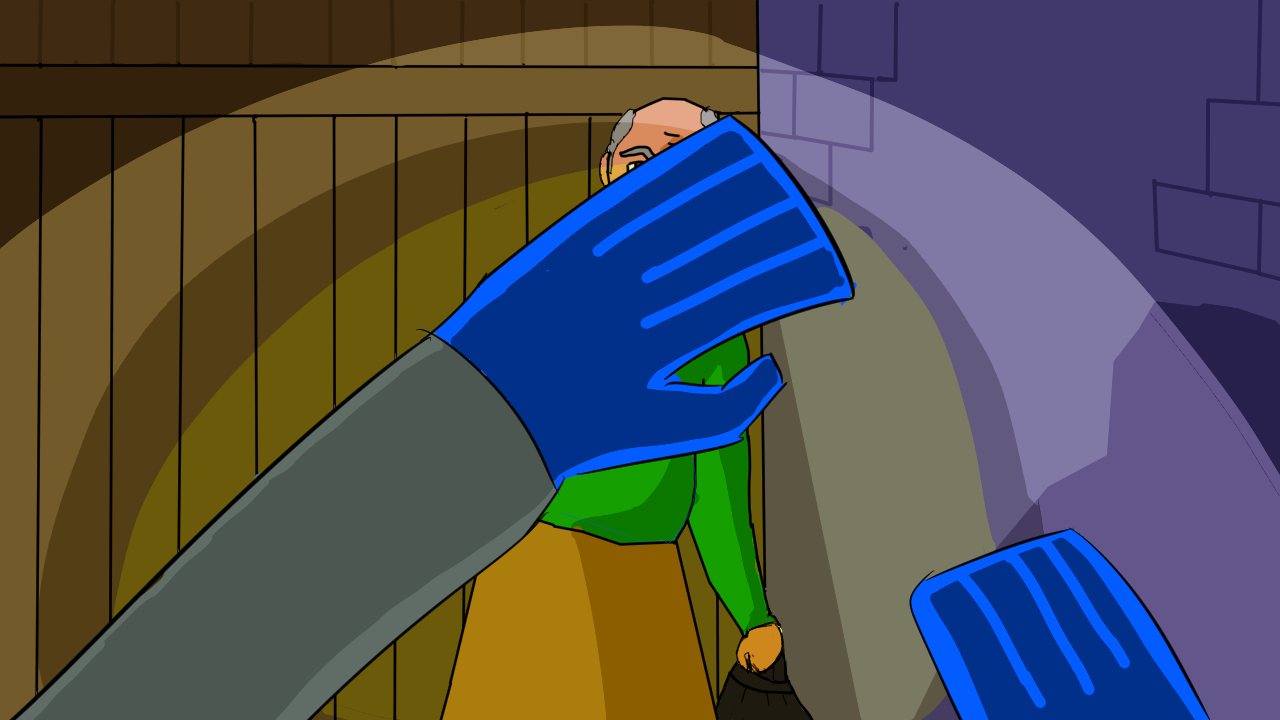
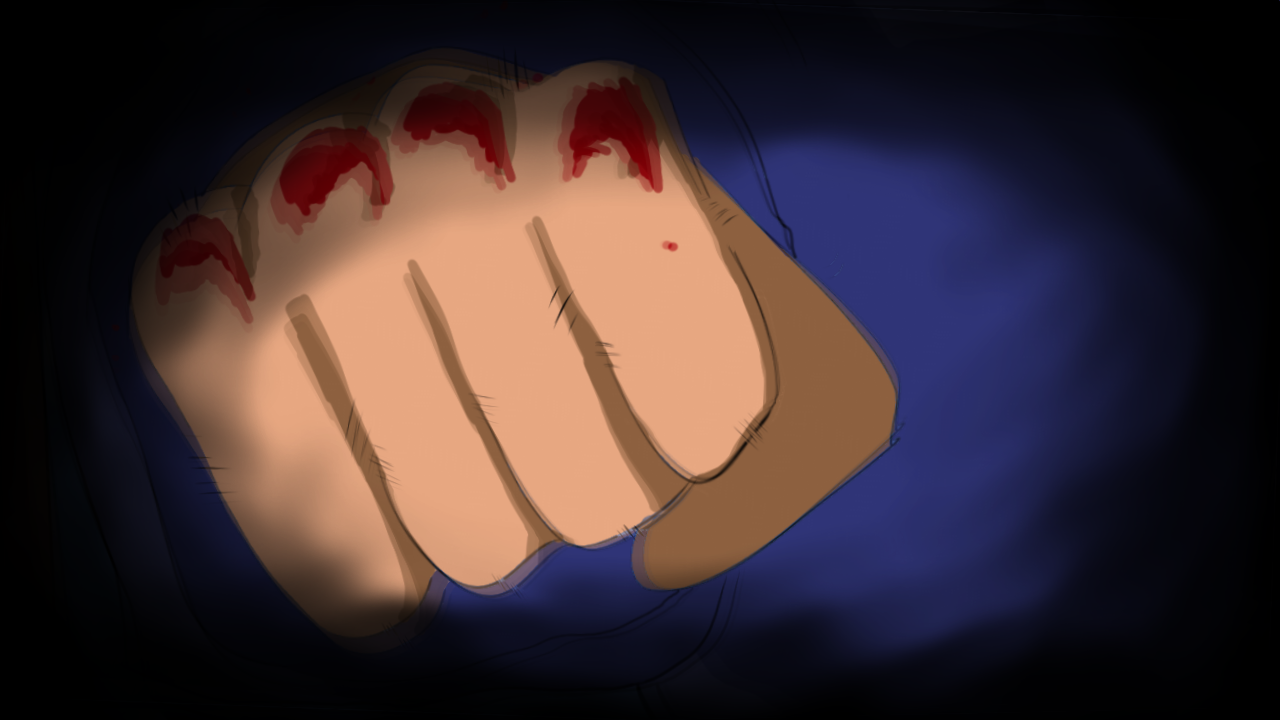
The second type of choice is where you decide what action you want to do in that moment. This can be type of action, or it can be specific depending on the situation. For example, you see a woman being attacked in an alleyway. In a fight, these options become even more specific. You can throw a right hook, use a brick on the ground or even kick at your enemy.
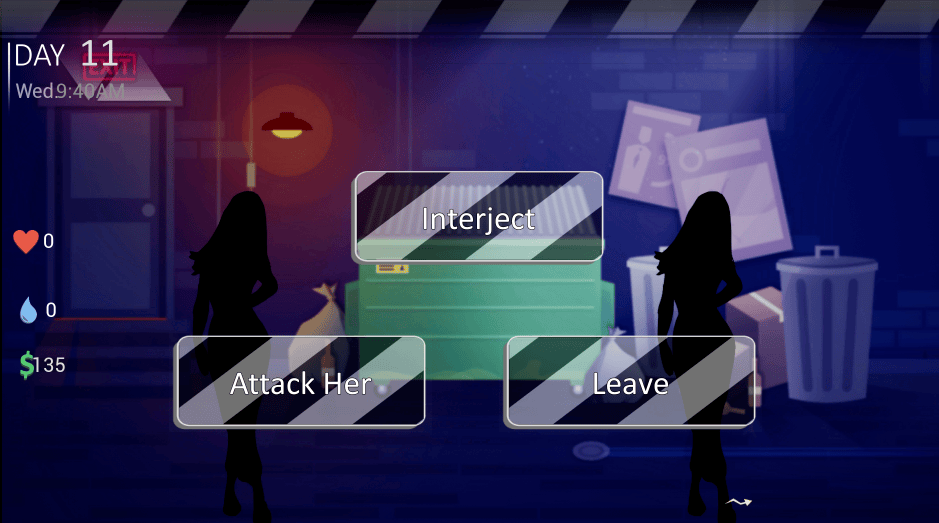
These type of choices are made in the moment, and take place at designated descision points during an activities scenario.
Choices can appear in different configurations depending on the situation when the player reaches a decision point. This can range from between 2 to 9 options being available to select.
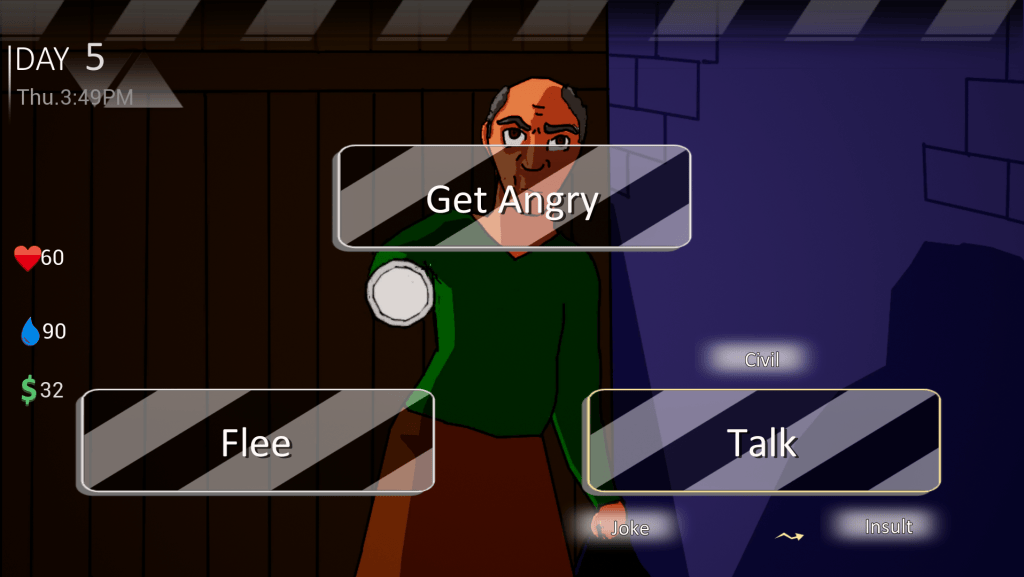
A maximum of three individual choices will ever appear at once at a given time. This reduces the visual clutter on screen and reduces how overwhelming it can be in the moment. When we want to show more choices, we convert an option into a category which can unfold to reveal three more choices.
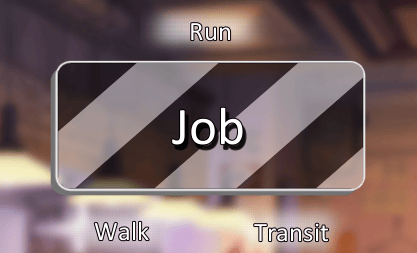
This approach ensures that the player’s desire to do an action is represented and they are able to commit to making a choice that they would want to make. It focuses their attention on key points of interest, reducing the cognitive load and allowing them to process and make decisions quickly.
Choice prompts are kept short, simple and straightforward supported by the context of the scenario to quickly communicate to the player the type of action a choice represents.
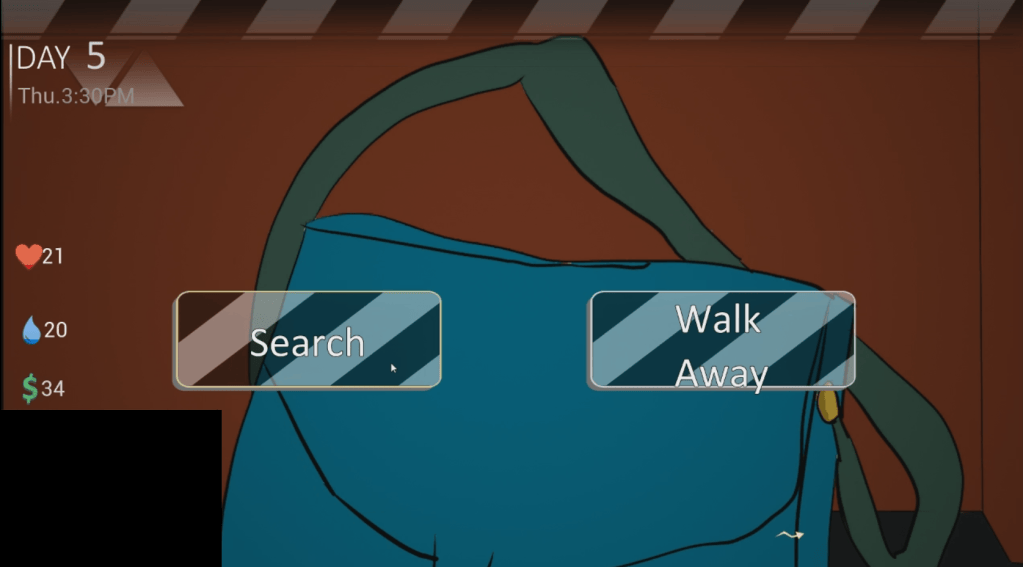
Decision points are designed around what options the player can do. This informs what the scenario needs to tell the player so they have all the information they need to understand and make a choice that reflects the action they want to take. The speed at which see, process and then decide can often trick their brain into creating a fast paced situation for high stake events.
Resources

There are four resources in “Home”, which are designed to represent the main struggles that would influence a person in homelessness. These are Wellbeing (Your ability to do things (0%-100%), Hygine (How others see you (0% -100%), Wealth (Your money in dollars), and Time (8am – 12pm, Day and Hours).
These generalized resources are simple, and easy to understand and more importantly manage. This allows them to be quiet in comparison to the decision making mechanic. Secondary resources such as hunger and clothing are treated as conditions that a player can get. These conditions influence the primary resources on a simplified scale, and as a result are also simple for the player to manage.
When a player makes a decision, the outcome of that decision is shaped by the resources they have. It changes the way a decision unfolds, which can grant them access to different options and outcomes.
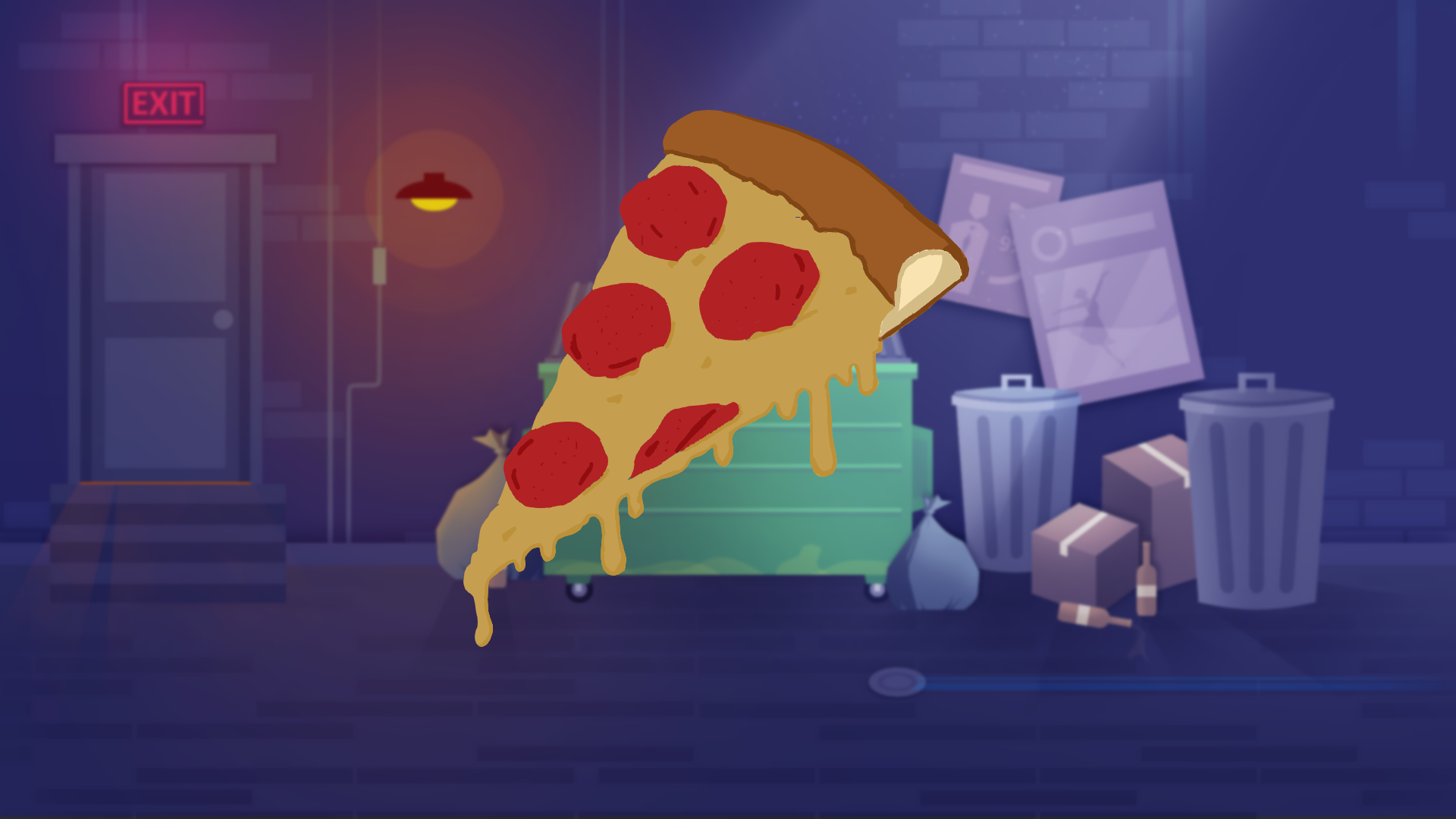
For example, a situation when you are confronted by a store owner as you are digging through his dumpster for food. You always have the option to attack him. However your wellbeing influences how well that can go. How well you can concentrate, how telegraped the action is, how much power you can put in the strike. Attacking the owner can end up with an outcome that ranges between them striking first, to you landing a heavy hit on him to create an opening, and everything in between.
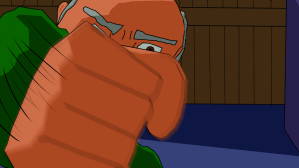
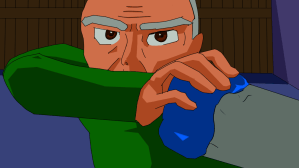
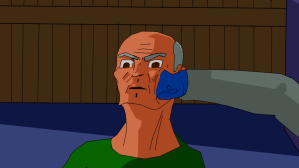
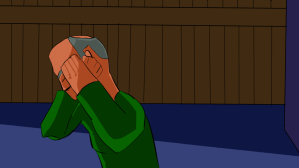
Sometimes low resources can act in your benefit as people might pity you and show you some compassion. Most of the time it will do the opposite, and you can end up in situations where you won’t be able to enter a restaurant because you smell and look terrible. While there is no minimum to particpate in an activity, some do have requirements to complete them such as doing your homework, or staying at a motel. Everything has a cost, but its up to you to decide how you want to be able to pay that cost.
The resource system is designed to support your ability to make decisions. Maintaining your resources will make the game exponentially easier, however, if you neglect them and wait until its too late. It can creates a snowball effect that can cripple your ability to choose. Keeping on top of everything will ensure that you are free to make decisions as you wish.
Your resources reflect what happens to your character during a scenario. When you are hurt, or put down you would feel bad and lose some wellbeing. If you fall into some mud then you would get dirty and lose hygine. When you spend money you lose wealth. Likewise, if someone gives you a nice warm meal then you’d feel better and you would gain wellbeing.
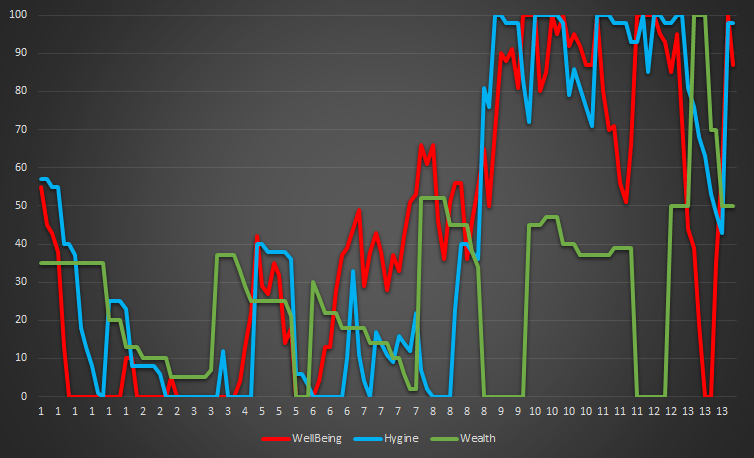
There are no tricks or hidden features to the resources system. This makes it simple to gain and lose resources, and also makes it easy to understand what makes them change, and why they change in that way.
Conditions like hunger act as a constant drain on your resources, but they are likewise simple to resolve. Do you have a broken bone? Go to a hospital. Hungry, eat some food. Are you clothes falling apart? Buy some new ones or try a donation center. This allows the game to be intuitive, as the challenge is not about finding out what to do, but finding out how to do things.
Your choices drive the resource system. It is designed to support and give you more options. If one way doesn’t work, there are always others. You don’t have to spend money on new clothes, or food. You can give up hygine to dive into a dumpster for food, or you can give up six hours and end the day to go and take a shower at a shelter.
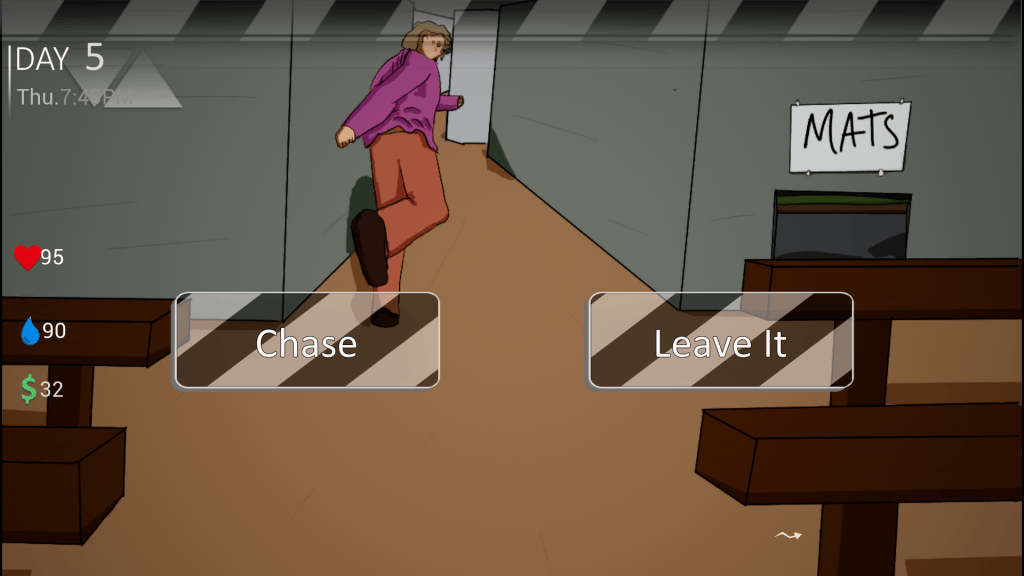
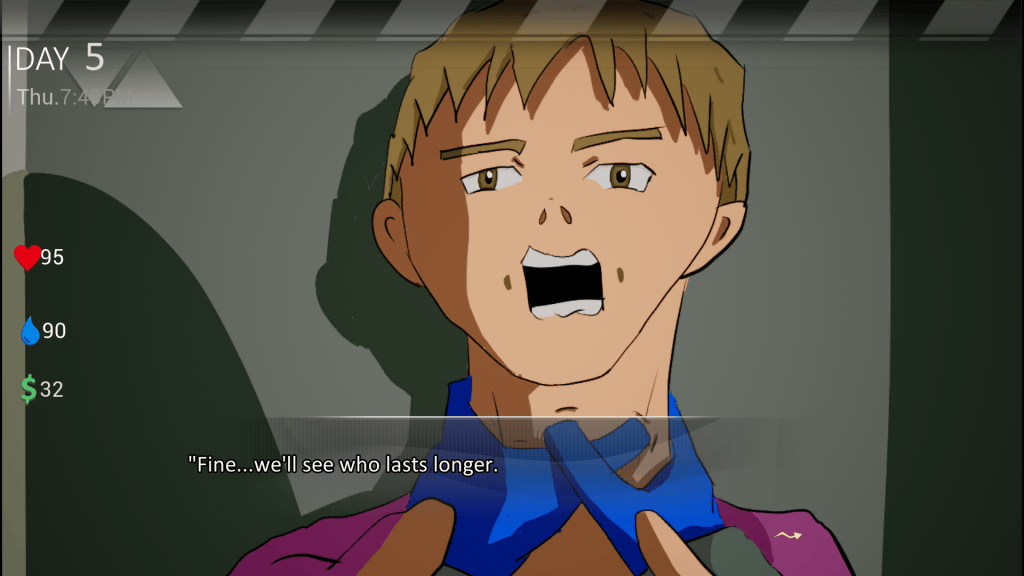
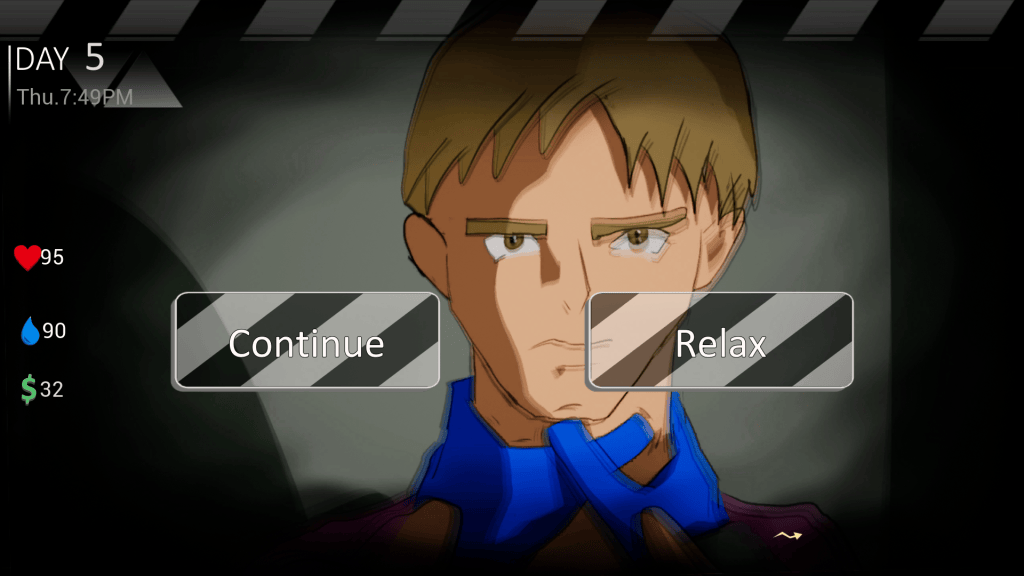
The impact on your resources is not binary. Your choices can reduce, improve or make the results worse. You can get robbed in a shelter you can decide to let the robber go, losing some wellbeing and wealth. Or you can chase after him and you can get your stuff back, or you may end up getting into trouble and risk getting kicked out on top of other potential outcomes.
This variance is important because we don’t want to create a game that you can just complete by knowing what the right answer is all the time. It needs to feel dynamic, and unpredictable at times. Because the resource system impacts your choices in this way, it prevents the game from feeling mundane, or solved. Otherwise, if you can just suceed by picking the right box, you are removing the player choices from the equation and devaluing their attempt at surviving.
Sometimes your resources aren’t able to support a specific action you want to do. You can still do it, and the game will allow you to fail. This is important because failure is a characteristic of the experience, and allows players to see that game respects their choices and allows them to make the choices they want to make. This in turn, builds outcomes that players respect and value.
Every scenario has an outcome that impacts your playthough when you complete it. Any changes to your character, or rewards will happen once the scenario has ended.
Doing this ensures that no matter what happens each scenario has a built in value and meaning. This is done through various short and long term rewards. The primary way this is done is by adjusting your resources. However, there are other types of rewards you can get depending on how complete a scenario, as well as how interacted with other factors throughout your playthrough.
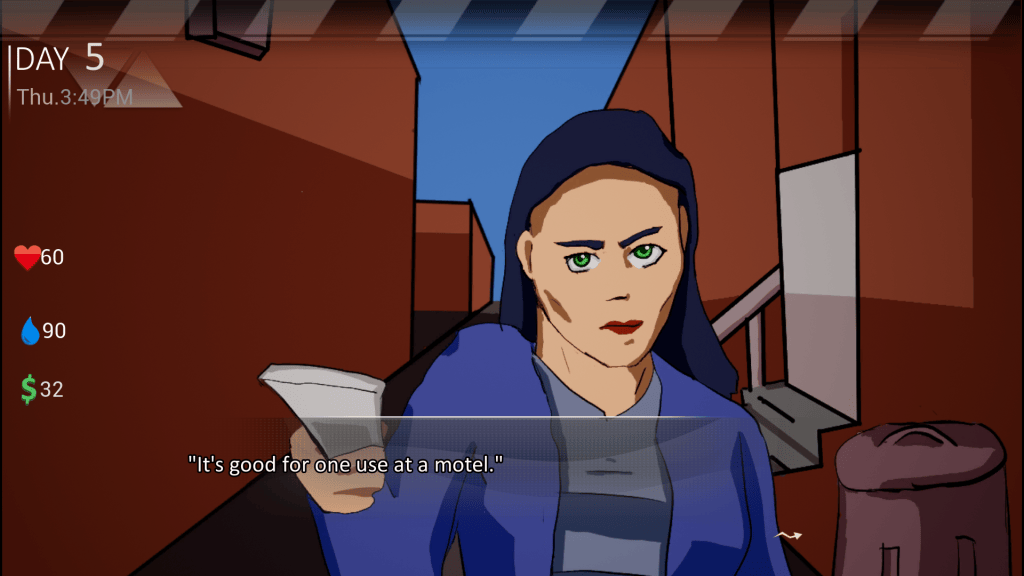
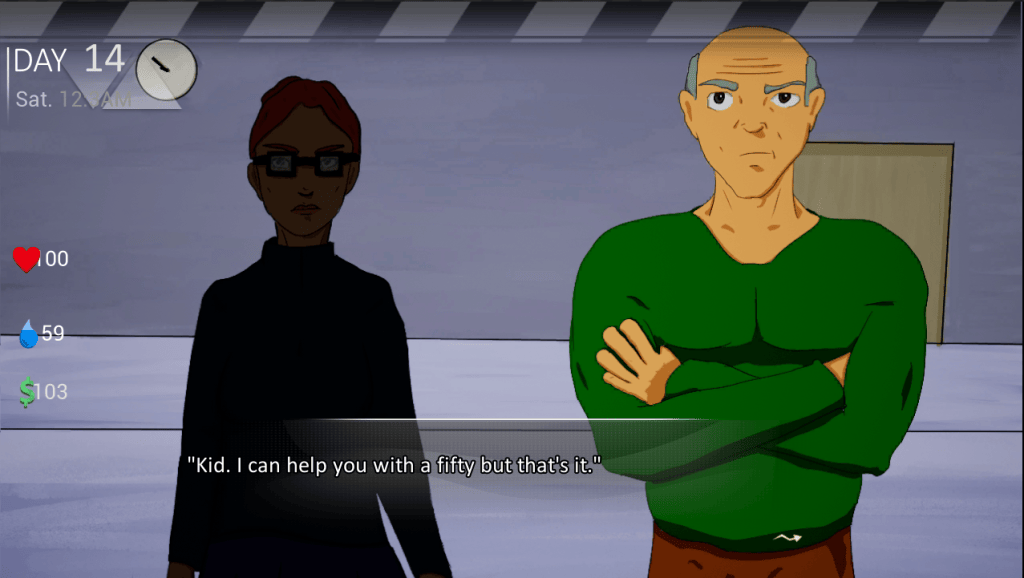
Some scenarios will give you a consumable resource, such as a motel voucher, a Meal, or a place stay for the night. Others can unlock access to other activities or scenarios that might be can lead to even better rewards.
The most powerful rewards are the ones that provide you with a permanent resource. This can be an unlocked area, a connection with a character, even a job. The homeless woman you donate some money to and rescued can come back and show you a safe and comfortable place to sleep and clean yourself up.
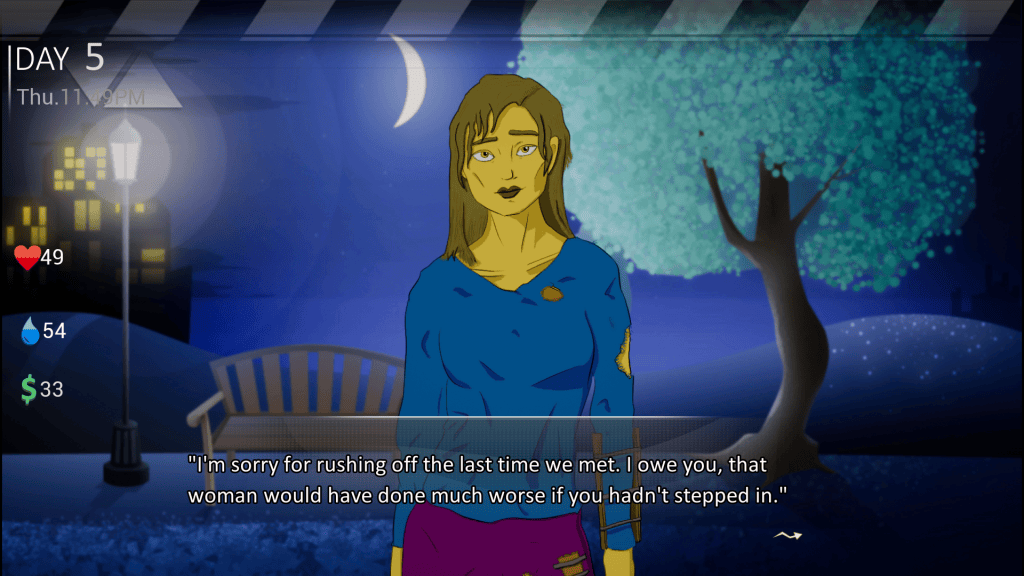
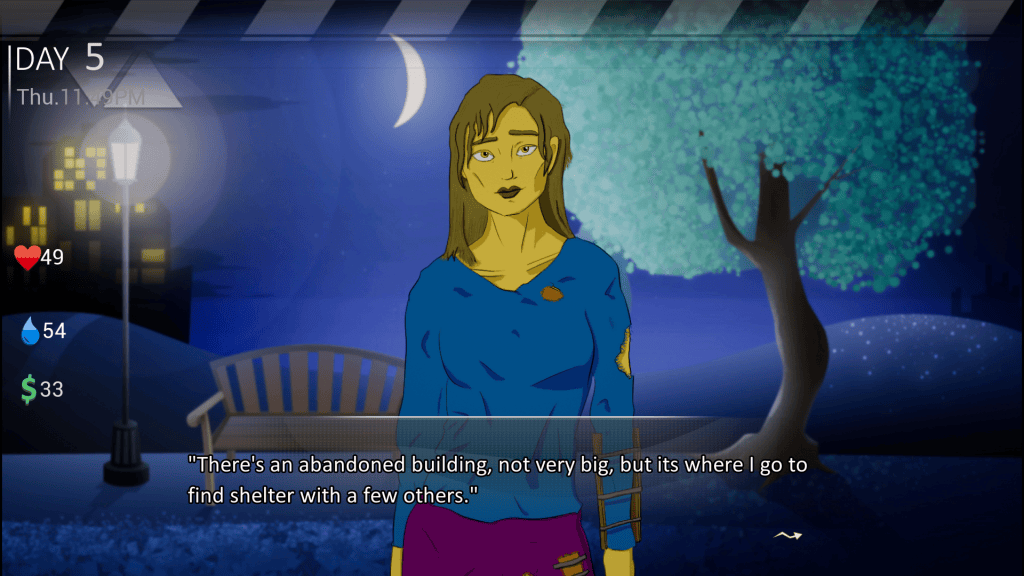
Some of these rewards don’t manifest until later. The police officer you talked down can give you a recommendation, or the restaurant owner you’re working for can help you with your rent payment. Rewards granted from long term or challenging situations often are tailored to alleviate specific burdens a player will struggle with.
This encourages players to both explore other areas of the game, and continuing engaging in other activities instead of playing it “Safe” because of the many ways the potential rewards can quickly turn their experience around.
They are given control over their experience amongst the choatic world they have to move through. In return they have to overcome “Fate”, which appears as the oppressive world around them that seems to want them to fail. Turning the concept of Fate into a villian allows players to see something that they can overcome in every situation. This turns every win they get into a victory over their enemy, and builds satisfication and value in every success.
Your time is limited, and you have to juggle your resources while still trying to complete your tasks and explore other side stories that interest you. Sometimes you are trying to cram so much into a short time, and other times it feels like you have to find something to fill how much time you do have. This concept is one important example I wanted to convey due to how misrepresented time is for those in that situation.
Scenarios
Every activity a player can do has its own list of scenarios. When a player selects an activity, a scenario in most cases is randomly loaded from that list. If you have ever played a game of “Tales of Arabian Nights” you will notice some similiarities.
Each scenario has different outcomes and variations that can be dramatically different from one another. Scenarios with higher levels of interactivity will have more variations because the player naturally add more complexity to it.
Depending on the situation, the player can pick how they want their character to act from a wide variety of choices. A scenario is designed around the different choices a player can make to ensure that they are able to interact in a way that they believe they should be able to.

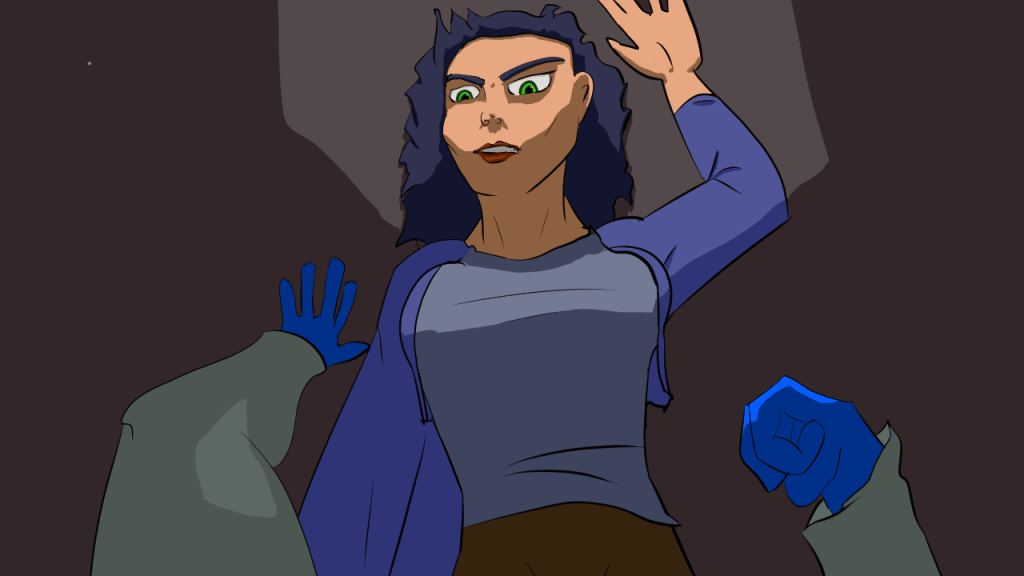
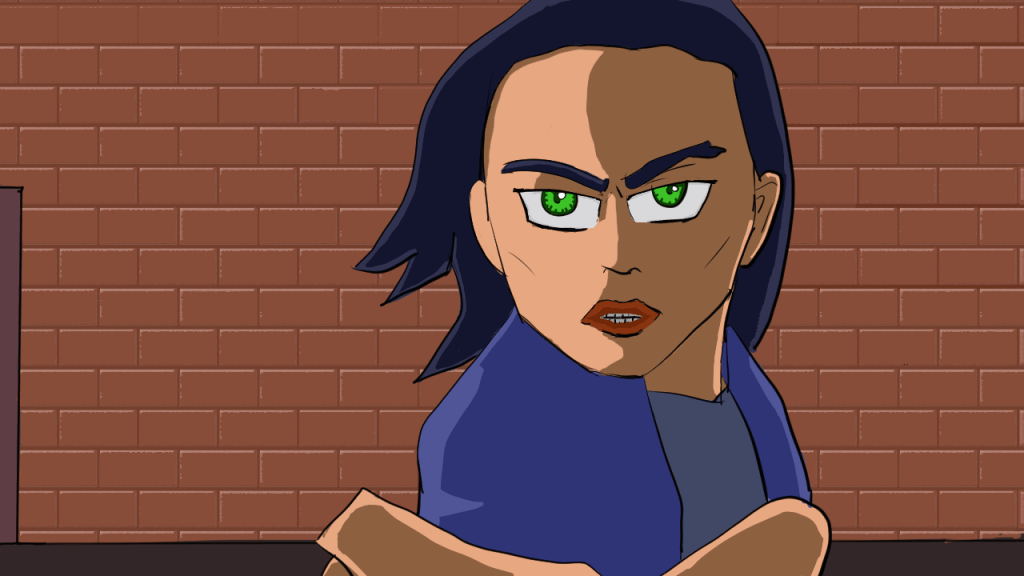
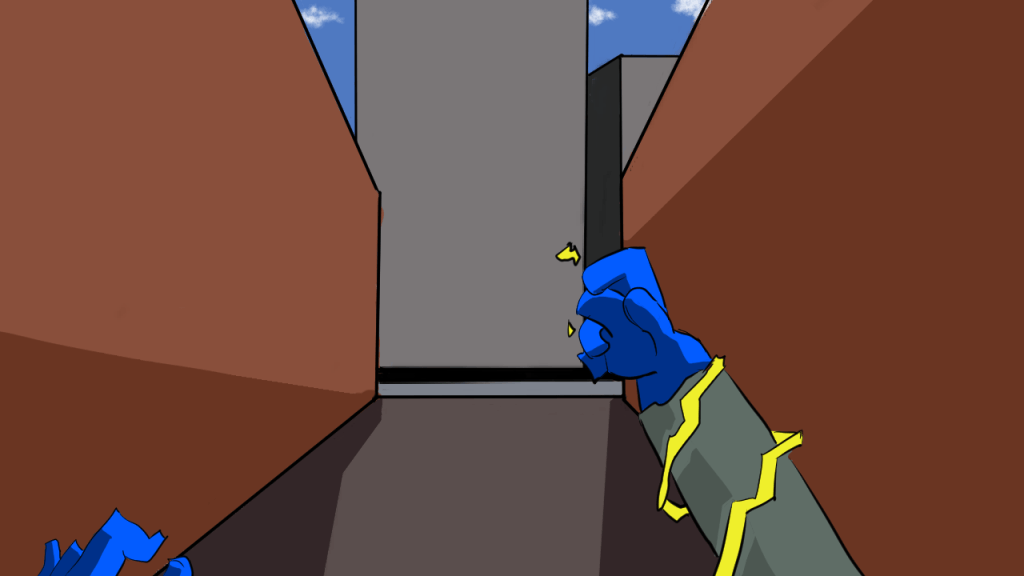
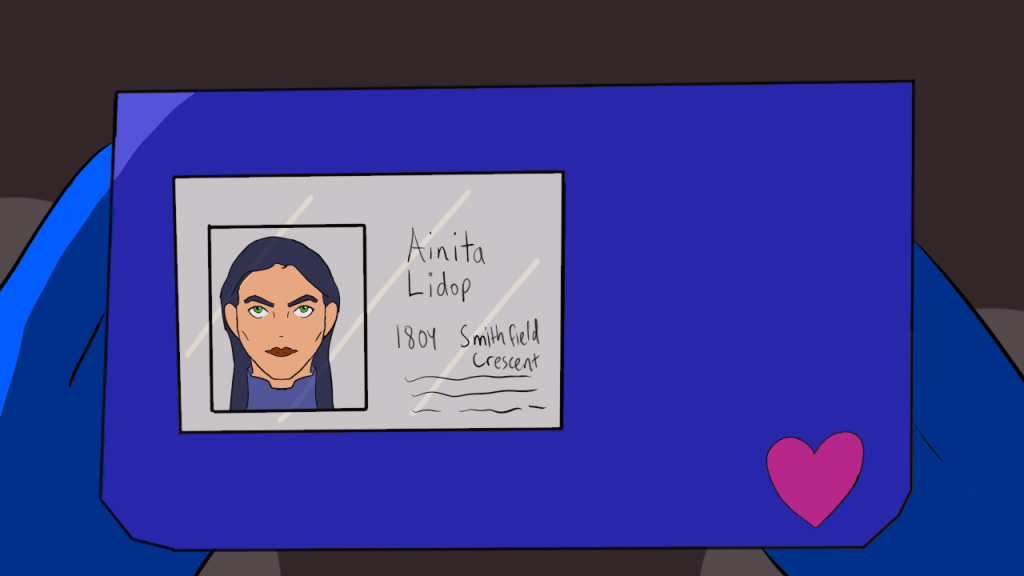
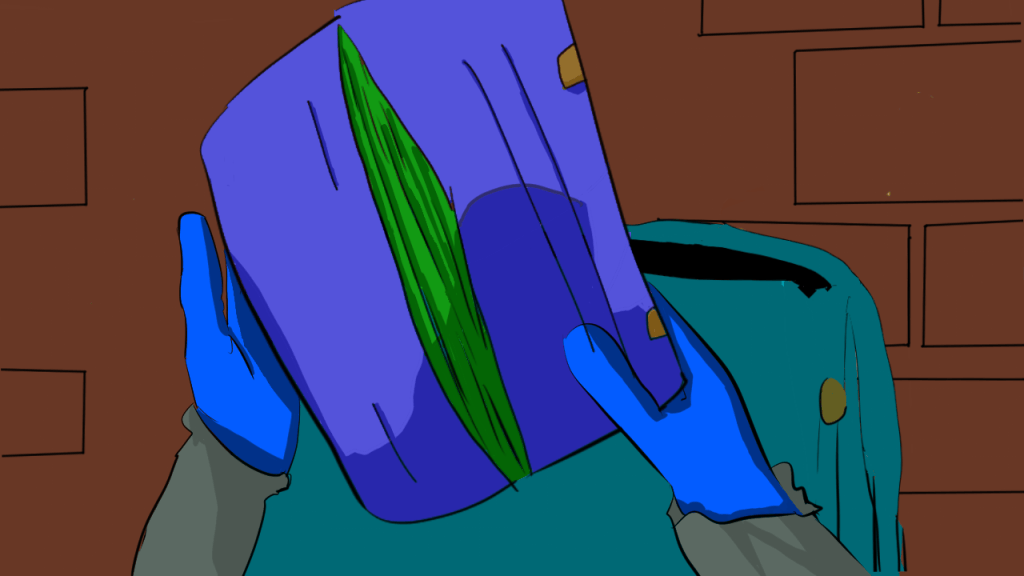
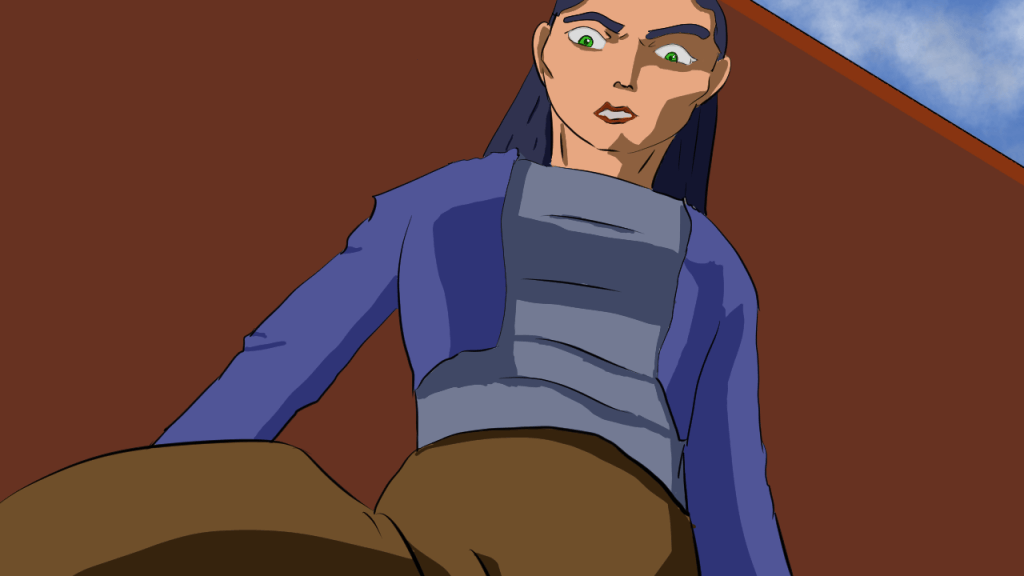
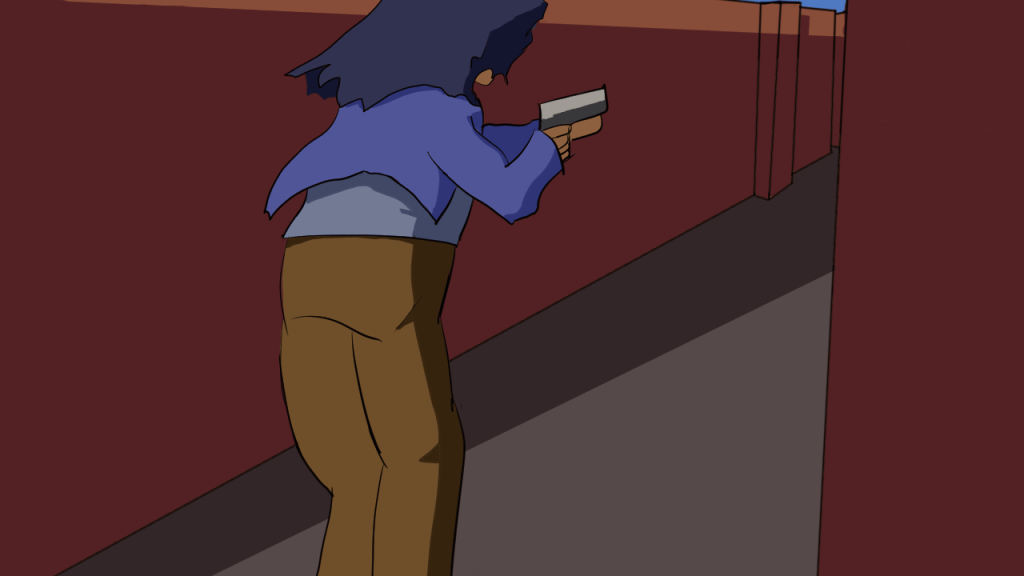
This does require a number of additional tweaks to routes, the scripts and images to ensure that the game feels like it is responding to your actions. It creates a reactive world that lets the player believe that the choices they make matter. By believing that they have some control over what happens in this chaos, they can feel okay investing more into the experience. It lets the world feel real and accepting of their presence in it.
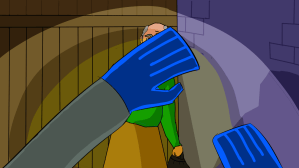
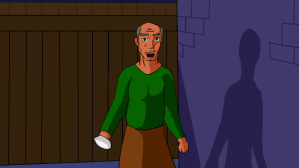
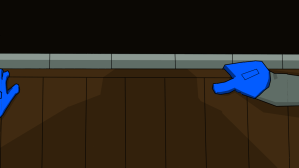
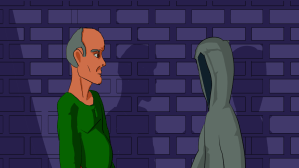
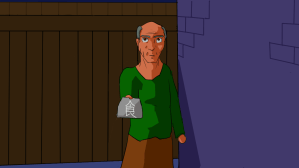
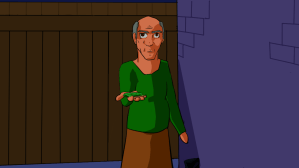
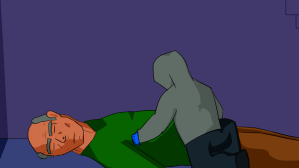
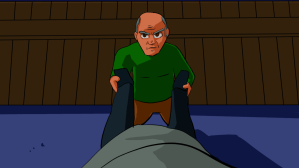
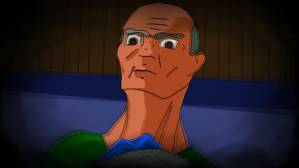
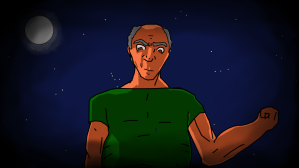
In the restauarant owner scenario, the situation can unfold in many different ways. He can give you some food and money. You can beat him up and steal from him. He can beat you up and leave you out on the street. Or he can send you on your way. In just these four distinct outcomes, there are a multitude of ways the situation can unfold depending on the choices the player makes. Each designed to feel organic and natural to the experience.
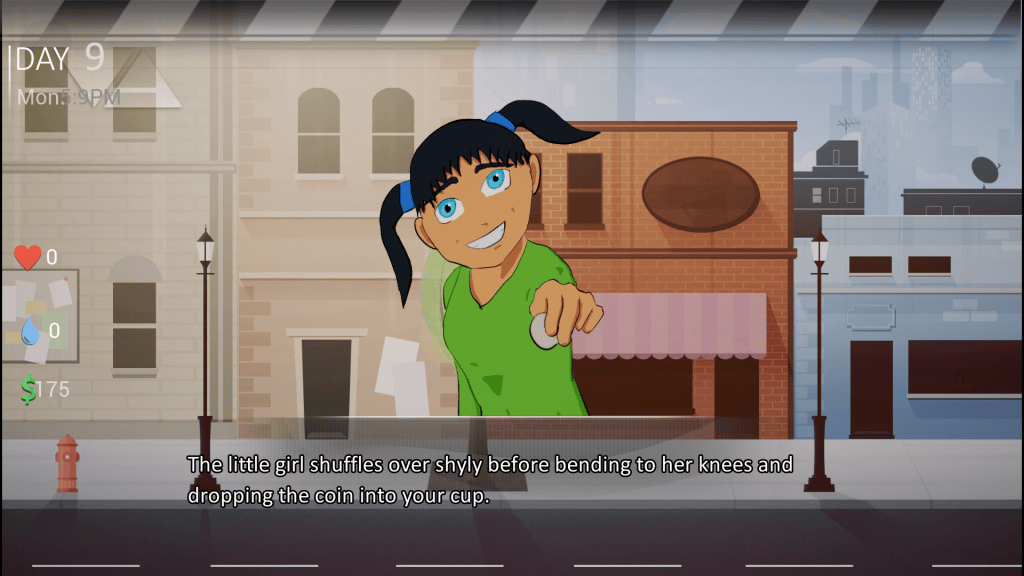
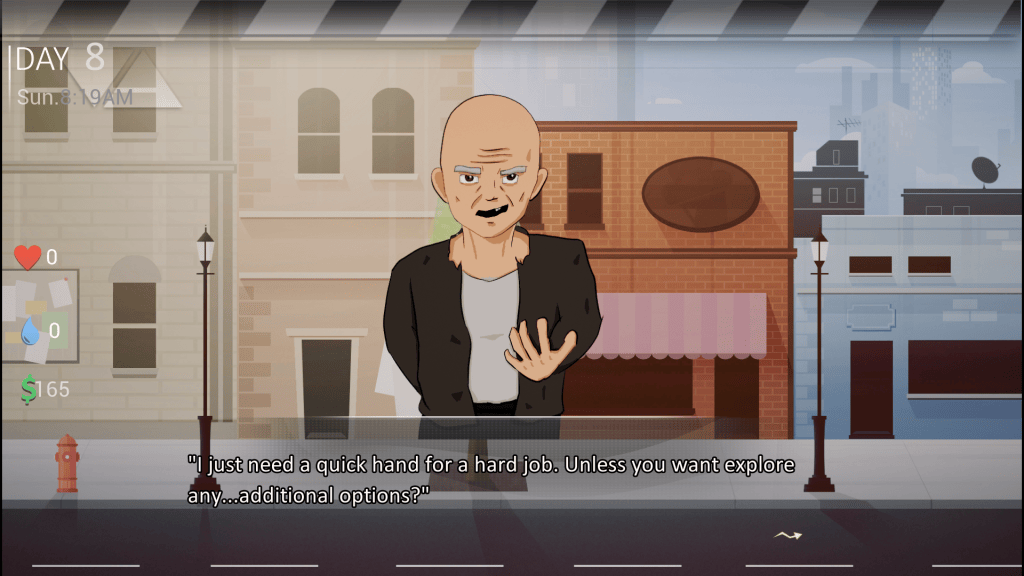
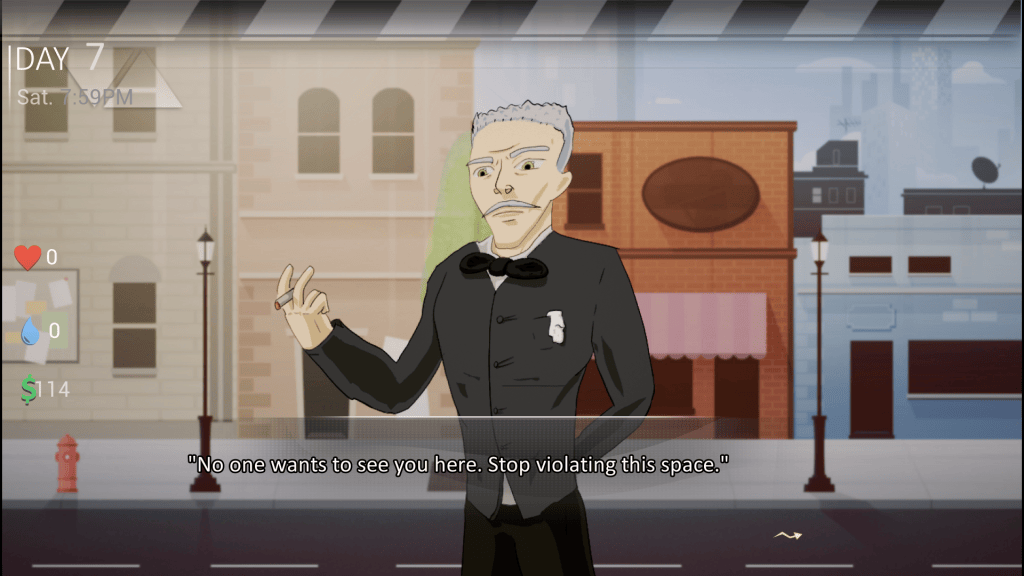
Each scenario has its own plot. “A little girl gives you money”, “You’re approached by a creepy old man,” “You see a homeless woman getting attacked in an alley”. Self contained stories, with simple descriptions that can cascade into complex interactions as the game goes on. This creates an identity for each scenario, and lets us explore and build interesting situations for players to interact with.
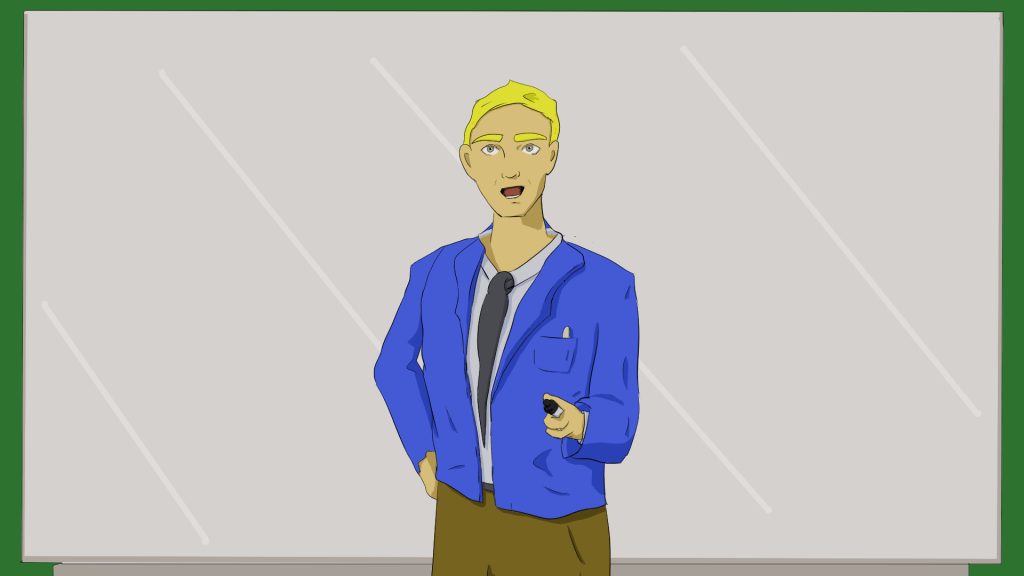
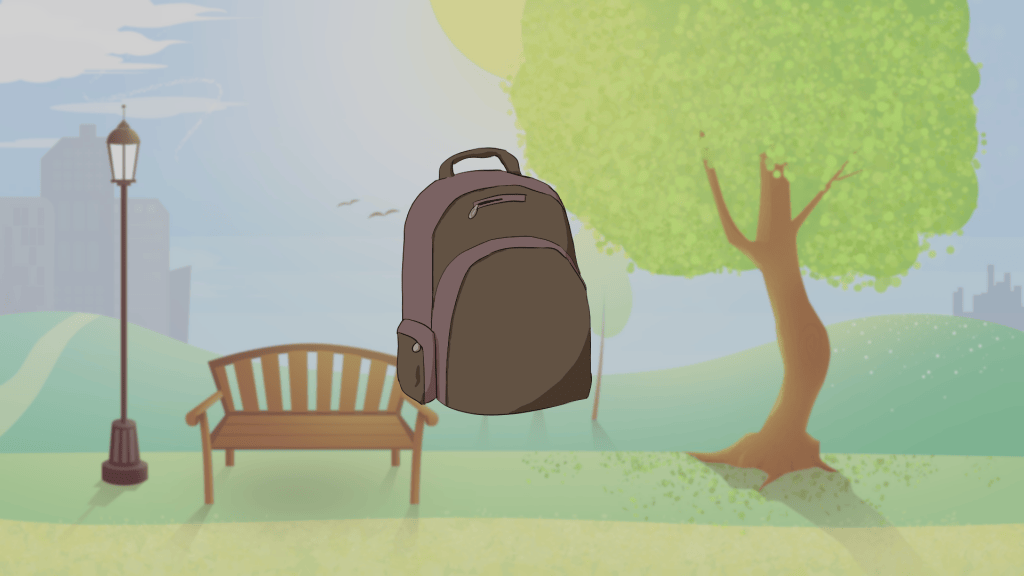
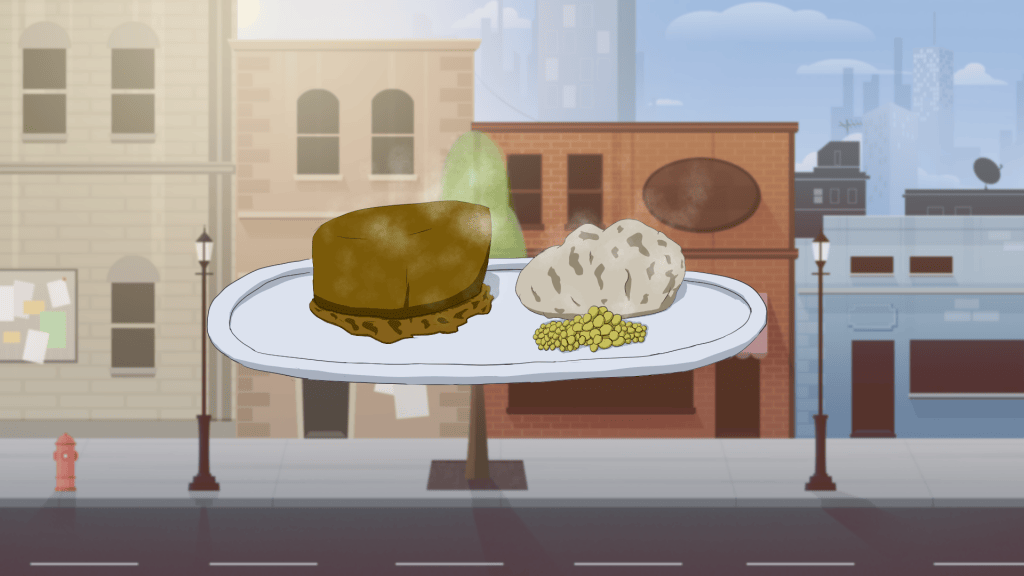
Stories like;
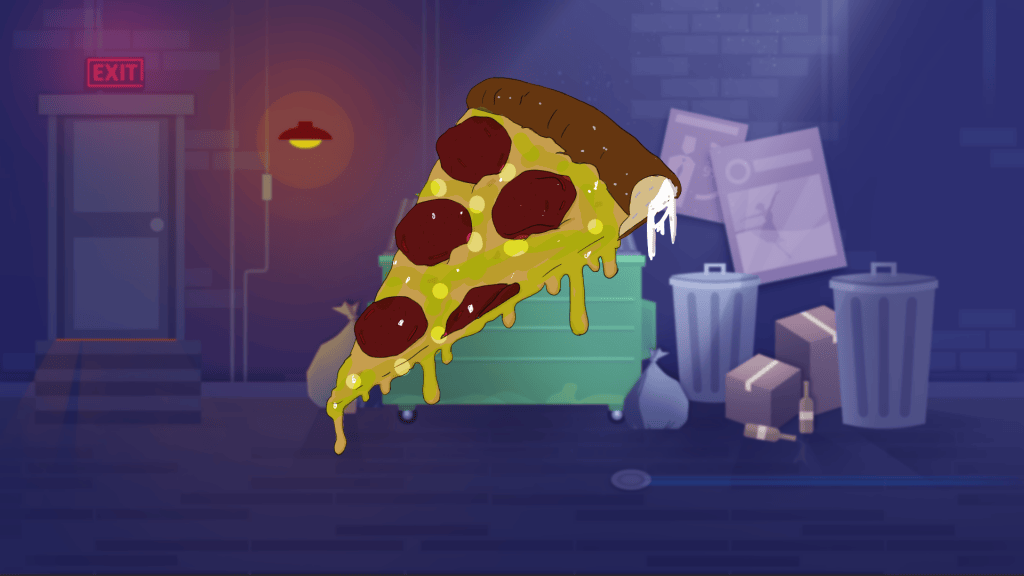
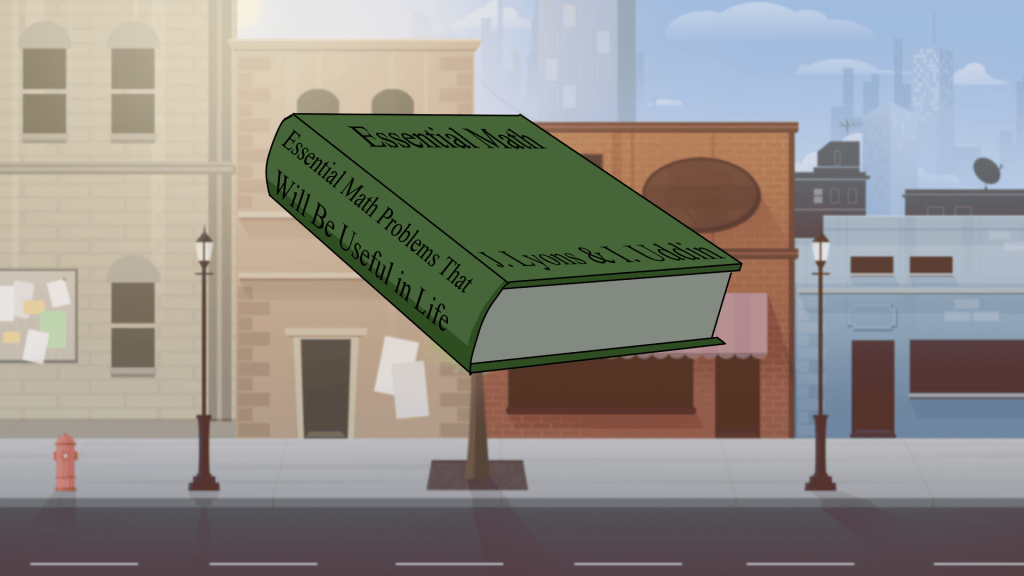
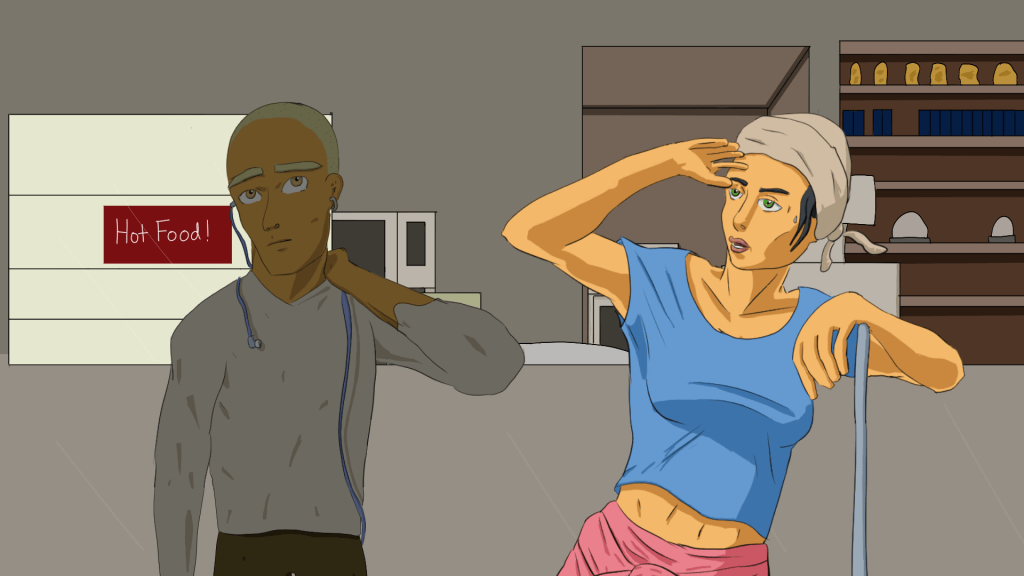
- Getting robbed at a Homeless Shelter
- Finding rotten food in a dumpster while you’re hungry
- Seeing a starving child trying to console her crying mother
- Getting accused by an undercover police officer.
- Getting caught by a restaurant owner while you are digging through his trash.
- Seeing an unattended bag in a park
- Seing a woman assaulted in an alleyway.
- Being accousted on your way to school.
- Helping a stranger move in to their new home.
- Working at a pawn shop
- Helping a friend with their personal troubles
- Attending Class
The list is extensive with each activity having a minimum of 10 scenarios each with thier own variations and outcomes.
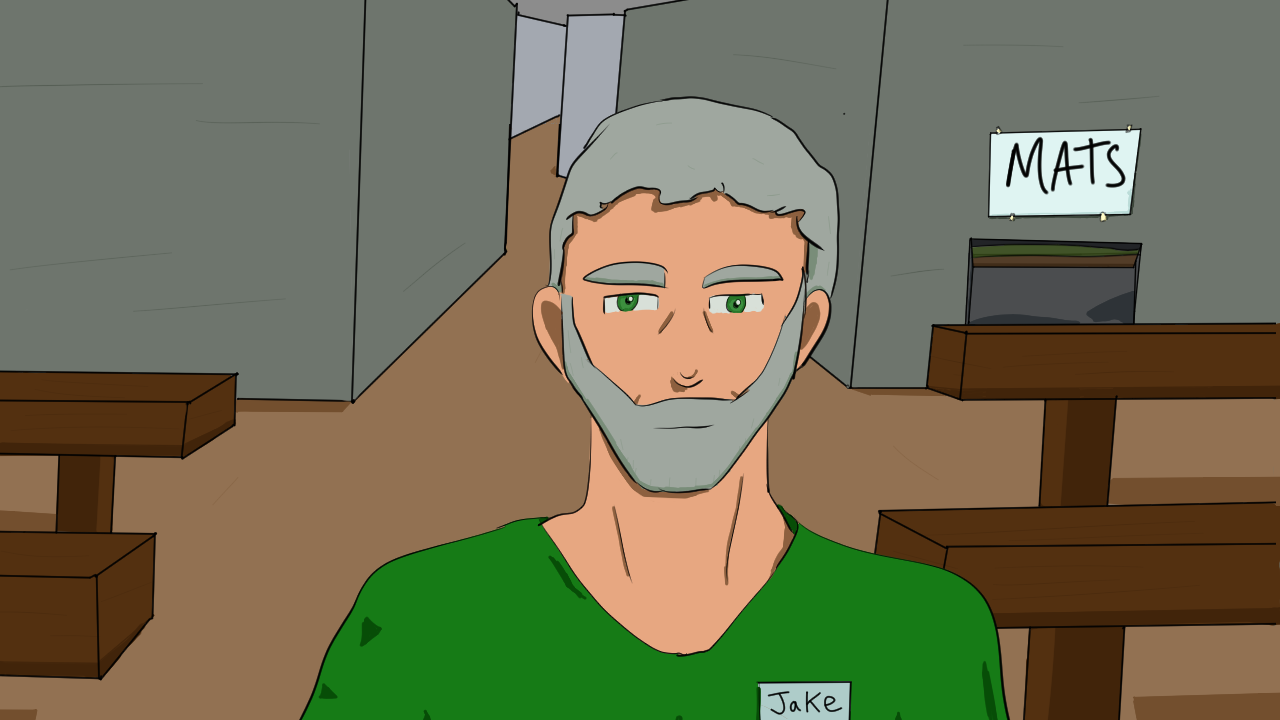
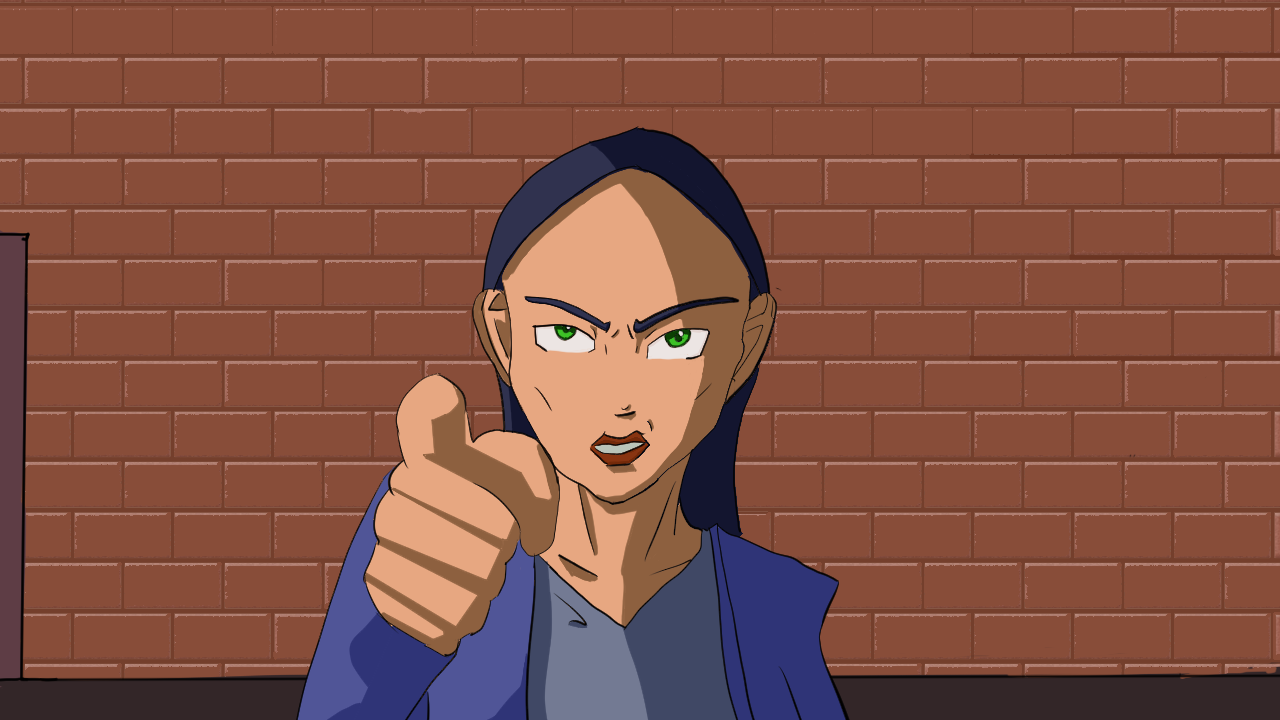
Just like there are a variety of stories, there is also a variety of characters to interact with. Strangers, friends, teachers and more. One example is the Homeless lady Celica who you can meet playing her guitar on the street for money. You can give her some money. Later on, you can help her out when she is being attacked. Connecting with her can lead you to a doctor and a safe place to spend your nights.
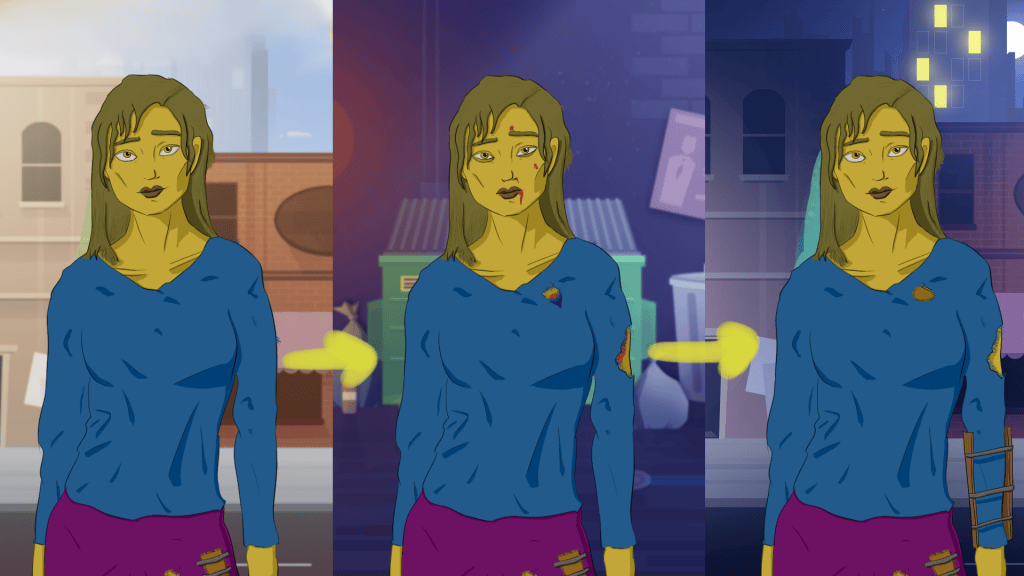
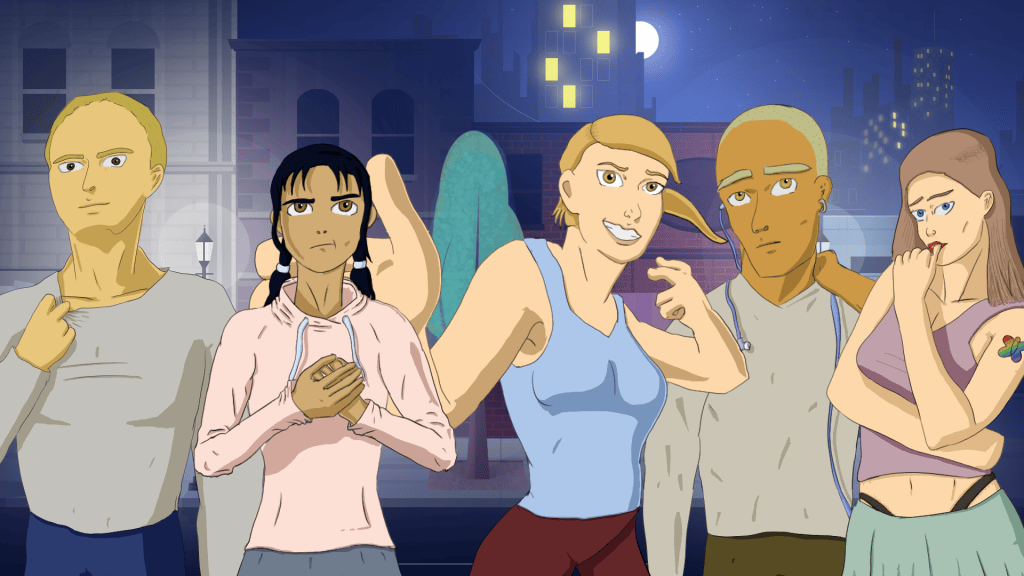
This gives the player different stories and perspectives that in many cases they wouldn’t be able to encounter or engage with. By allowing the player to be not just the victim, but a bystander or a hero in other characters story it allows for not only a shift in perspective for the player but also many more layers of interaction and connection that would not be possible otherwise.
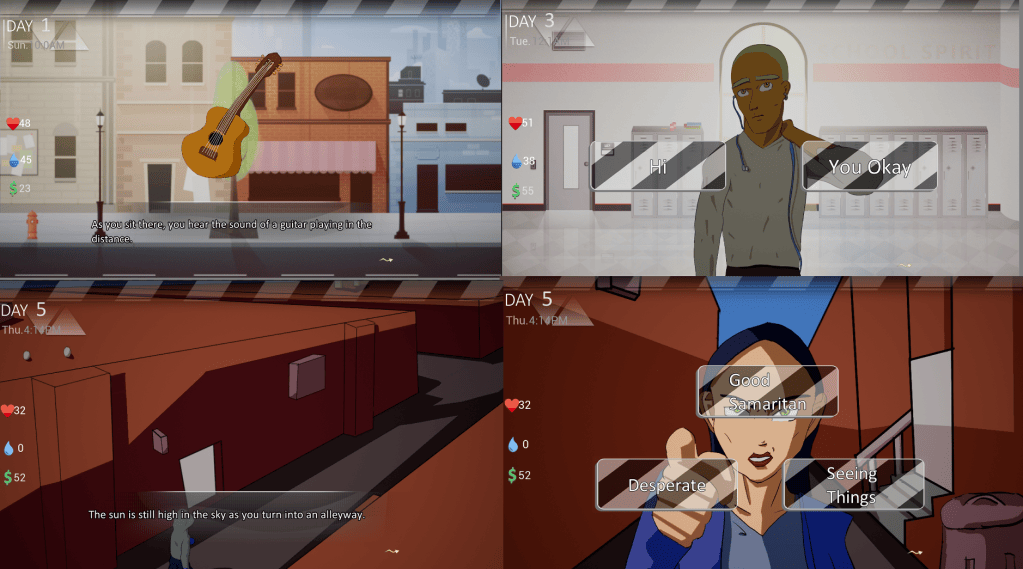
There are three classifications a scenario can have based on how interactive they are. These are;
- Stock: Short 30 second scenarios that are told as a short narrative. They have different variations and outcomes based on the resources a player has. They use icons to represent actions, and generic area appropriate backgrounds to tell its story.
- Interactive: 1 to 2 minute scenarios that take you through an interactive story. These contain one or two key decisions that that can influence the path of the story, along with the resources that the player has.
- Crisis: The most intense and interactive scenarios that feature a lot of choices that have to be made in a short period of time. You are put in a crisis like situation and you have to get out of it. This story is shown through a first person perspective, similar to an animatic and features a wide range of options, variation and outcomes that are designed to enable you to act how you want to in that situation.
Having scenarios of different levels of interactivity provides a balance between ensuring that can embrace interacting with scenarios at different levels, but also ensures that they have areas where they can relax, or make less intensive situations.
Each activity belongs to one of four categories. Each catageory shows three main activities, and each activity would have three sub activities. For example, the food activity would allow the player to select how they wanted to get food. These would be through Dumpster Diving, Getting Fast Food, or going to a Restaurant.
These four categories are;
- Focus: Time consuming activities such as going to school, government tasks, and working a job. These were only available in the morning.
- Permanent: Short activities that are dedicated to managing your resources. They are available all day, and include activities related to taking care of yourself, changing clothes, making money, and more.
- Recreation: Activities that involve homework, hanging out with friends, going swimming. The activies you can pick are randomly selected from a list of recreational activies everytime you revisit the “Hub”. This option replaces the Focus activities group after 3pm.
- Sleep: At the end of the day the player has to pick where they want to sleep. A park bench, motel, a friend’s house, the homeless shelter.
A player could toggle between two categories at a time, with the sleep category becoming mandatory at the end of the day.
Playtesting
The game was tested using a number of Games User Reseach methods prior to the final build being submitted which was used to evaluate various designs and verify different areas of the game.
The primary method used was through video recordings of participants and gameplay, where they performed a think aloud as they played, providing information on their thoughts and actions. The video captured their unrestrained speech, mannerisims, posture and other visual movements.
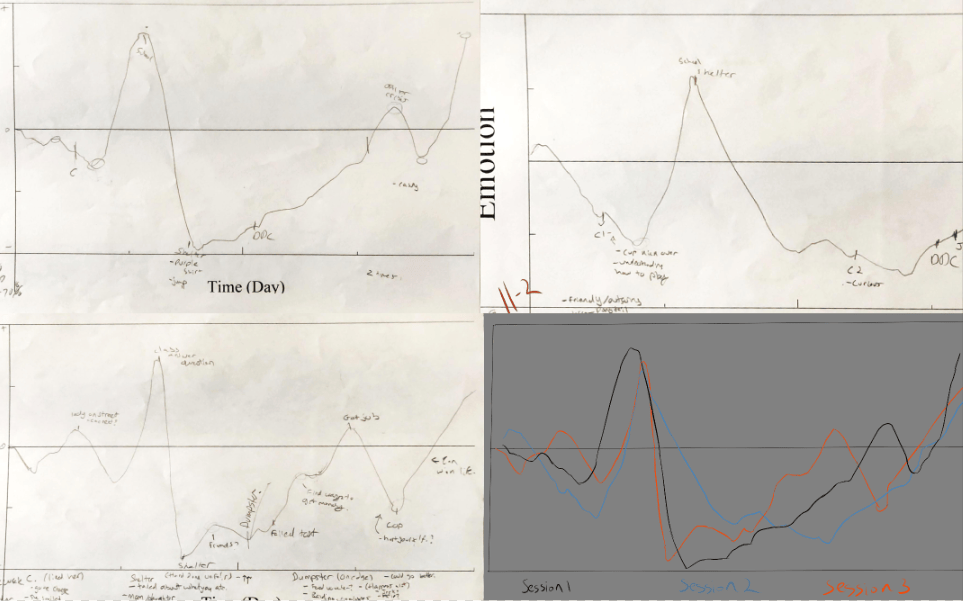
The second method involved running three interviews with each participant. One took place right after they had played the game. The second took place one a week after they had played the game. The final interview happened a month after they had played the game. Each interview took around 30 minutes. At that time each particpant drew out a curve of their own emotional experience during each interview which was compared to one another to evaluate how they differed over time. They were also compared with their gameplay recordings, and interviews testing for memory retention and accuracy.
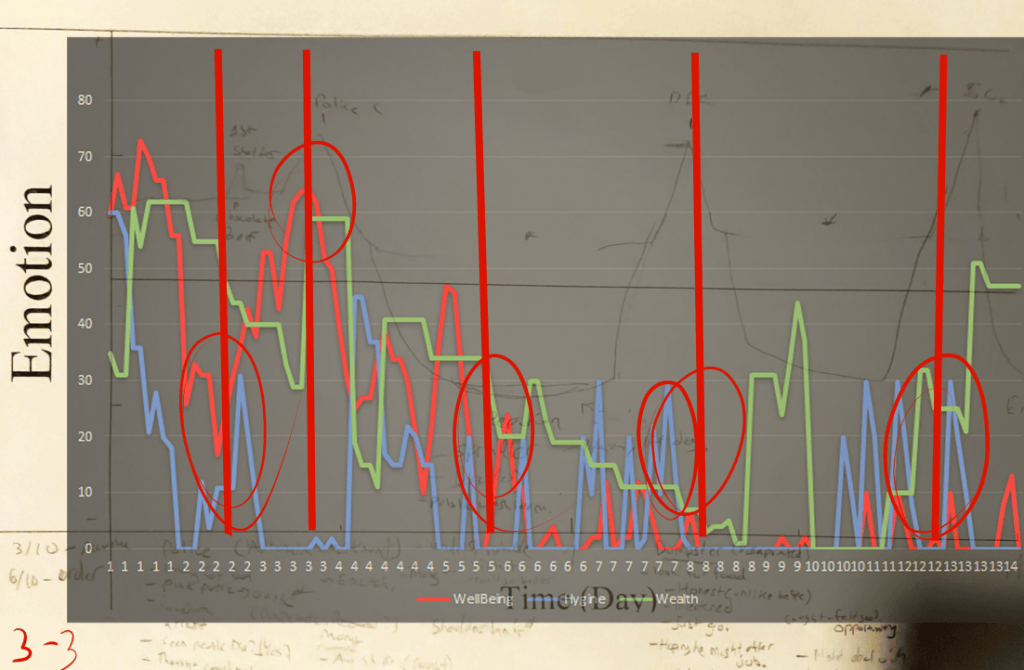
In terms of game data, each participant had their resources tracked over the course of the game showing how they changed over time. This was then compared with the other methods.
Each source of information was used in conjunction with one another to evaluate points of interest, areas of the game and ways a player would view different scenarios and interactions.
For example, most people’s emotional curve drew significant matches with changes in their resources. However the events they attributed those changes to were different which suggests how we may link events together through shared emotional responses. Events would appear out of order, or have inaccurate reports that could be easily justified by a bias.
By combining these data points, we can identify ways to improve how players learn and apply information like controls, game mechanics, character connection and more to capture player’s attentions and create engaging situations for them to immerse themselves in.
As this game was created while I was undertaking my Master’s in User Research and game design, I utilized this data as a part of my own thesis which you can find online if you wish you learn more.

